 Saifullah Ahad
How I built it
 Temelie: Math Learning GapsLive on Google Play
Temelie: where to start when a child is stuck in math
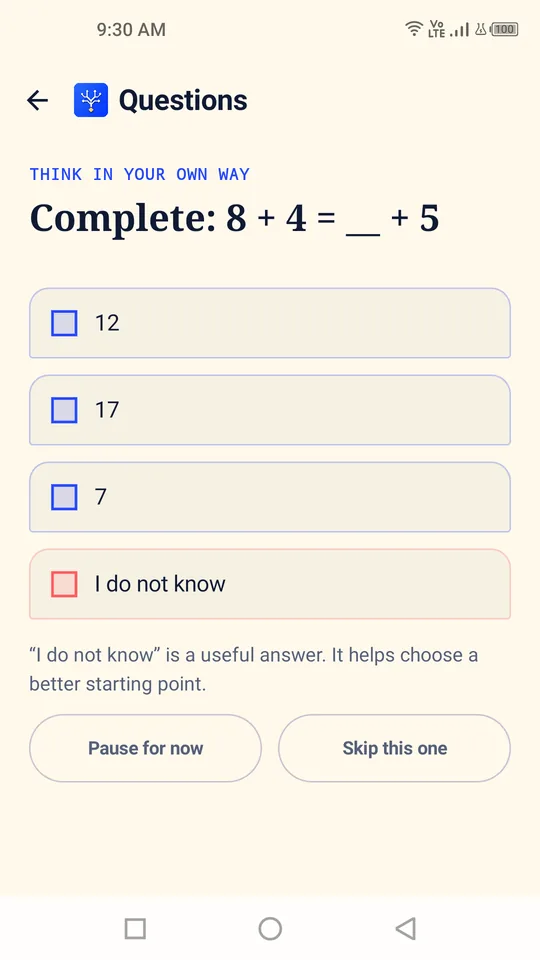
For a child who is stuck in math, and the trusted helper beside them: a parent, an older sibling or a teacher. A short check, one suggested starting point, and one ten-minute activity with ordinary objects.
01
The problem
A child is stuck in math, and the person beside them, a parent, an older sibling or a teacher, needs to know where to begin.
02
The plan I wrote
The child answers a short check of up to eight questions. "Pause", "Skip this one" and "I do not know" are on every question. There is no timer and no score. The child never sees a score, grade, level, percentage, rank, streak or right/wrong flash.
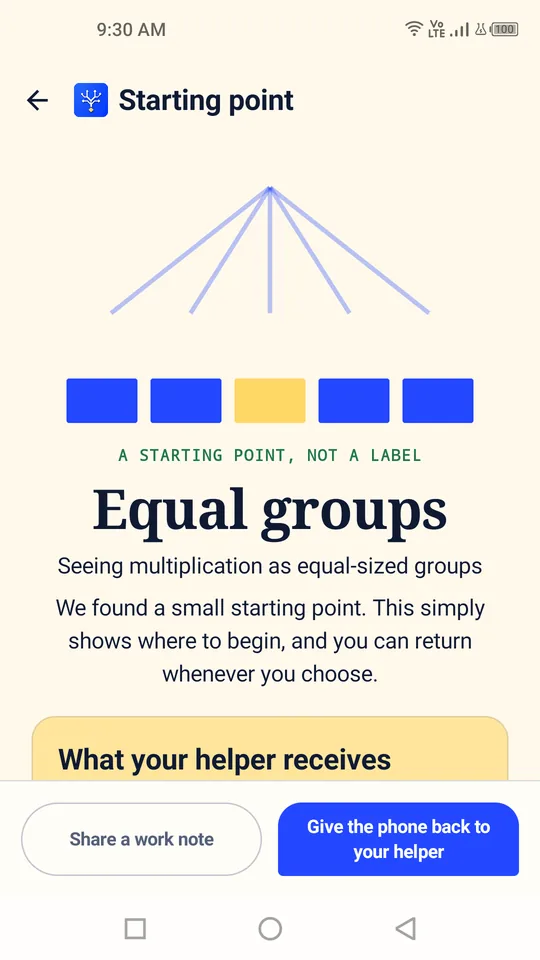
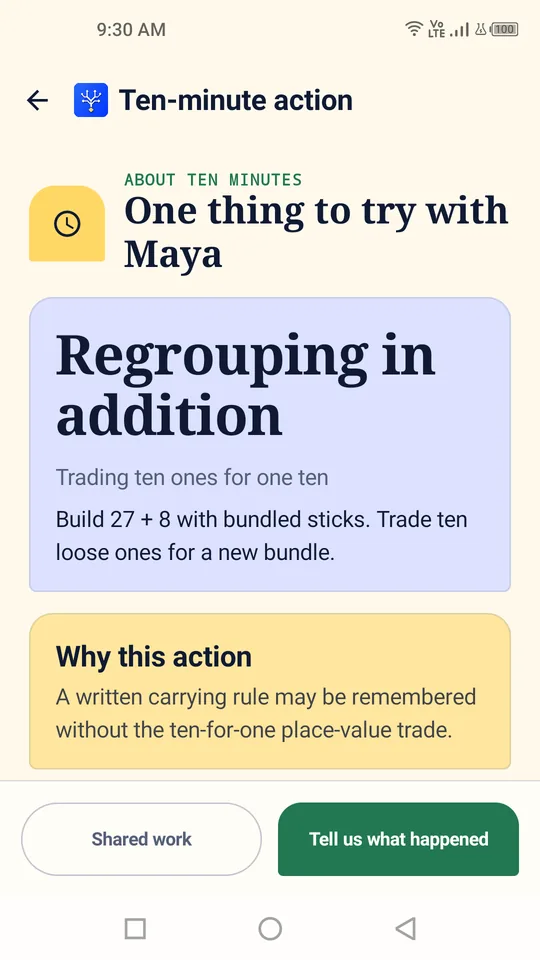
The app then suggests one starting point and gives the helper one ten-minute activity with ordinary objects. It can also say "Nothing broken in what we checked", or "We need another short check" when the answers say too little. After trying the activity, the helper taps what happened: Got it, Got it then lost it, Not yet, or We could not try it. The next step changes with it.
It covers 26 foundation ideas, from counting through one-step equations, in English and Bangla. It works two ways: one shared phone with no internet and no code, or two phones joined by a one-time code. In one-phone mode no data leaves the phone: no server call, no sync, no analytics. Its working name was Armat; it was renamed Temelie before release.
03
The build
Built the way I build every app: I write the specification and the tests, AI coding agents build it, and every release is checked on real phones and tablets before it ships.
04
What the testing caught
On October 5, 2026, while taking new store pictures, a sample student called "Sam" got the wrong result. Sam did 8 + 5 by making ten and got subtraction right, but answered both equals-sign questions as if "=" means "write the answer next". The app said "Addition as joining"; a teacher would say "Equality as balance".
So an exact copy of the old logic was run on 26 pretend students, each missing exactly one idea and answering consistently. It found the right starting point for 8 of the 26. With realistic slips and lucky guesses it was wrong 75% of the time.
Why, in plain words: ideas with many ideas built on them were pushed up the list even when they were probably known; credit for a right answer reached earlier ideas unevenly; and the first questions spent too long on the equals sign.
05
The fix
The new logic keeps every possible picture of the child: one idea, and everything built on it, not yet known; nothing broken; or answers that tell us little. Each picture is reweighed after every answer, and the next question is the one expected to remove the most doubt. If no picture is strong enough, the app says it needs another short check. An optional first question lets the helper say what the child is working on now, or "Not sure".
06
The proof
In tests with 26 pretend students, each missing one idea, it found that idea for all 26 (the old logic: 8 of 26). With slips and lucky guesses, it was exactly right about half the time and one step away about a fifth of the time, and it says when it is not sure (the old logic: wrong 75% of the time). These are software results with assumed error rates, not children.
The phone and the online service give the same result on 618 shared test cases. The signed release was checked on real devices, an Infinix phone on Android 10 and a Galaxy Tab S3 on Android 9: updating keeps every student and answer, one phone, two phones on the live service, the lock, Bangla, and tablets. These checks also caught and fixed dark-mode contrast, seven Bangla words misspelled by the writing tool (now guarded by a test), page width on tablets, and typed text lost when turning a tablet.
07
Where it stands
Version 1.3.0 is live on Google Play as "Temelie: Math Learning Gaps". There has been no real classroom test yet. Only a test with real children can say how it does, which is why I am asking for help below.
What this shows about how I work
- A wrong result is traced to its cause and measured, not hidden.
- Results are reported with their limits: pretend students are not children.
- When it can't be sure, the app says so instead of guessing.
More build stories: How to check a used phone before buying · Eelj: a fair turn for a village’s one harvester · Practicing stuttering techniques at home · Where and when to look for the new crescent moon · How to check a link before you click it · How to settle who owes who in a group · How to describe a car noise so a mechanic can find it
Math teachers, tutors and parents
Try Temelie with one child, and tell me honestly.
If you teach or tutor math, or you are the parent of a child who finds math hard, please try it with one child. The app is in English and Bangla.
- Install Temelie from Google Play.
- Tap the green box "We share one phone".
- Add the child by nickname, choose what they are learning now (or "Not sure"), and hand over the phone.
- Before looking at the result, note where you think the child should start.
- Compare, and tell me honestly: same as mine, different but useful, wrong, or can't say.
Please send no names, photos or recordings of children, and ask the parents' permission first.
I am preparing applications to the MIT Solve 2027 Learning Challenge and the 2027 Tools Competition with Temelie, so honest answers help.