 Saifullah Ahad
All twenty-seven build stories
 Oinordetza: Estate SharesLive on Google Play
Oinordetza: how to divide inheritance in Islam, step by step
When someone dies, the estate is not simply split between the family. Two public sources, a Sharia court in Singapore and Egypt’s fatwa body, show what is settled first and who receives a fixed share. You can follow them without installing anything.
The order an estate is divided in
This page is not a ruling. The sources are from Singapore and Egypt, and the schools of law differ on some cases. Before anyone acts on a figure, confirm the family’s case with a qualified scholar or the local Sharia court.
What comes out of the estate before any share
The Syariah Court of Singapore’s brochure on Faraidh says the heirs’ rights begin only after these are dealt with: debt concerned with the estate, such as zakat; funeral expenses; the debts of the deceased; and the will of the deceased, up to one third of the estate, for people who are not heirs.
Egypt’s Dar al-Ifta agrees that bequests are carried out before the estate is divided, citing the Quran’s words “after the payment of legacies and debts”.
The two sources differ here. The Singapore brochure says the beneficiaries of a will cannot be any of the lawful heirs who receive a share. Dar al-Ifta says a bequest to an heir or a non-heir, up to one third, needs no consent of the heirs, and that anything above one third is carried out only after the heirs authorize it. Which rule applies to you is a question for your scholar or court.
Who has a fixed share, and what it is
The Singapore brochure calls them the Quranic heirs, because the Quran fixes their shares. It lists the husband, wife, mother, grandfather, grandmother, daughter, son’s daughter, full sister, consanguine sister, uterine sister and uterine brother. The list is the brochure’s own and may not cover every case.
The brochure quotes Surah An-Nisaa, verse 11, and one Egyptian fatwa from Dar al-Ifta gives a husband’s share. Here is what they say, in their own terms.
| Heir | Share | What the source says |
|---|---|---|
| Sons and daughters | 2 to 1 | “For the male, what is equal to the share of two females.” (Singapore brochure quoting 4:11) |
| Daughters only, two or more | two thirds | “For them is two thirds of one’s estate.” (Singapore brochure quoting 4:11) |
| One daughter only | one half | “And if there is only one, for her is half.” (Singapore brochure quoting 4:11) |
| Each parent, when he left children | one sixth | “To each one of them is a sixth of his estate if he left children.” (Singapore brochure quoting 4:11) |
| Mother, no children and the parents alone inherit | one third | “For his mother is one third.” With brothers or sisters, “for his mother is a sixth.” (Singapore brochure quoting 4:11) |
| Husband, no inheriting descendants | one half | An obligatory share, “due to the absence of any inheriting descendants.” (Dar al-Ifta, a fatwa for a woman who died leaving a husband, a maternal sister and cousins) |
| Maternal sister in that same case | one sixth | An obligatory share, because no other heir eliminated it. (Dar al-Ifta, same fatwa) |
Who receives what is left
The brochure gives the Prophet’s saying (Bukhari and Muslim): “Give the appointed portions to those entitled to them. Then whatever remains is for the nearest male.” It calls these relatives the agnatic heirs, who receive any residue after the Quranic heirs, and lists the son, father, brother and uncle among them.
In the Egyptian fatwa above, the husband takes a half and the maternal sister a sixth. The remainder goes to the three male paternal cousins, divided equally, as universal heirs (asabah), because there was no other fixed share and no closer heir. The Singapore brochure adds that when none of these relatives exists, the balance falls to Baitulmal, which Muis administers in Singapore.
Neither source walks through every family, and the schools differ on some cases. Confirm yours with a qualified scholar or the local Sharia court.
Oinordetza does the same steps in order, and the arithmetic.
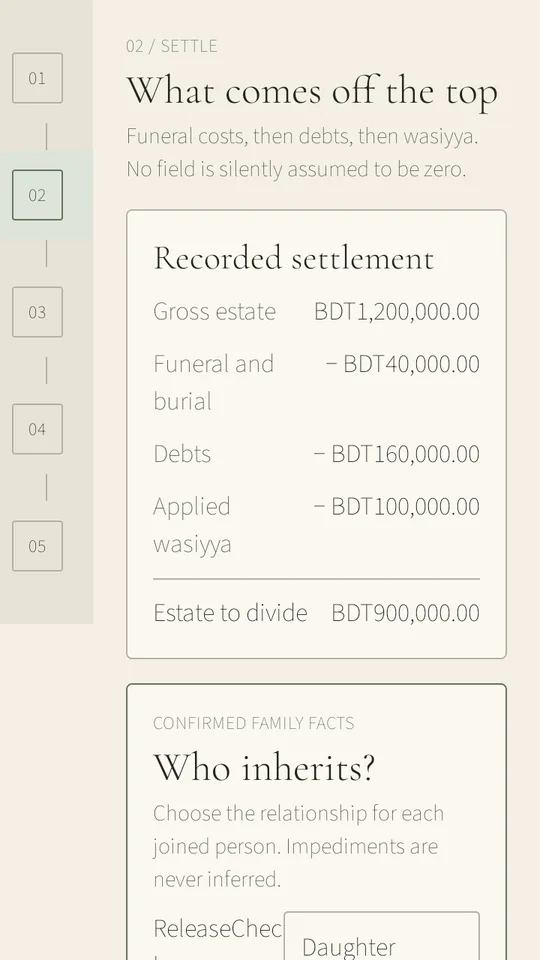
Oinordetza: Estate Shares is an Android app for one family’s estate. Named heirs join the same estate with an invite code. On 02 / Settle, called What comes off the top, the gross estate, funeral and burial costs, debts and wasiyya are entered in that order. If the wasiyya is above one third of what is left after costs and debts, the app caps it at one third.
Under Who inherits? you choose each person’s relationship and select Calculate cited shares. The app shows exact fractions, not decimals, under the Hanafi, Maliki, Shafi‘i, Hanbali and Ja‘fari treatments, and says Schools differ on this estate when they do. Its records name five cases where the treatments differ and the app shows the difference: the Umariyyatan cases, Mushtaraka, Akdariyya, Minbariyya and a grandfather with siblings.
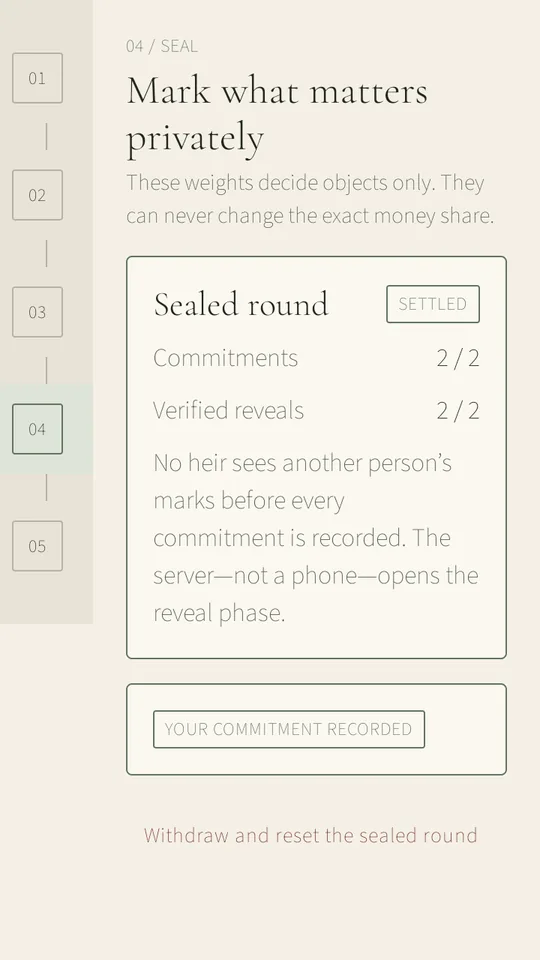
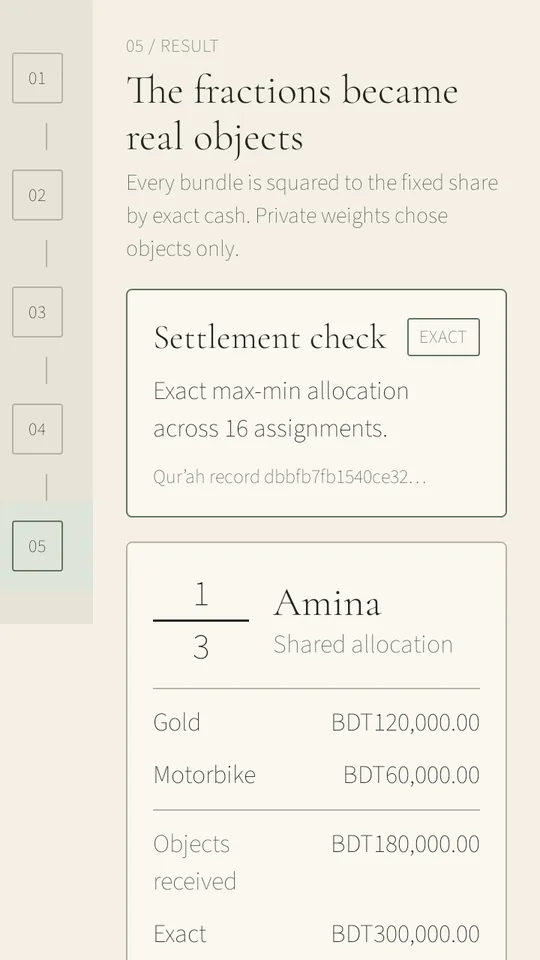
Then comes the part the app adds: who gets which object. Each heir marks what matters through Seal my marks and random seed, nobody sees another heir’s marks until every mark is recorded, and Solve objects and exact cash gives each heir objects plus a cash amount that adds up to that heir’s exact share. The app states who pays whom. It never holds or moves money.
These three pictures come from the app’s store gallery. The estate, the names and the amounts in them are demo data.
What it keeps, and where
Because the estate is one record shared by named heirs, it is kept on the app’s service as well as the phone. Per its privacy policy that covers the email address, display name, estate and heir facts, money values, notes, optional photos, approvals, sealed-round records, results and audit history. Cloudflare holds the records and photos, and Google Firebase handles app checks and optional alerts.
Estate content is shown only to that estate’s members and these service providers. The policy says the data is not sold and the app has no advertising or analytics code. A local copy and the secret for your own sealed marks stay on the phone, and Android cloud backup is off. In Settings you can export a copy or delete the account; an owner must close any estate first. Read the privacy policy.
Where it stops, and what I did not check
The app says its result is not a fatwa, court order, asset appraisal or payment service. I found no record that any scholar or body approved its results. It handles a husband or wife, sons and daughters, a son’s son and daughter, father and mother, a paternal grandfather, both grandmothers, and brothers and sisters of each kind. It stops and shows no share when a person is missing, a child is unborn, paternity is contested, a state or court rule may override it, a ruling is needed or an heir is outside what it handles.
For this story I read the store listing, the code, the test files and the privacy policy, and looked at the store pictures. I did not run the app or its tests, and I did not try it with a real family.
View Oinordetza on Google PlayKnow a family that needs a tool like this?
Tell me who it is and what they have to do.