 Saifullah Ahad
 HiveNoteLive on Google Play
HiveNote: a beehive inspection checklist, and how often to check
Utah State University Extension gives a short checklist of six things to look at each time you open a hive, and says to open it about every two weeks in the active season. A University of Minnesota bee lab adds how to score what you see and why to write it down. This page puts both in one place for anyone with a notebook. HiveNote, an Android app, comes after.
Utah State University Extension: the same short checklist, every time you open the hive
- Brood“Look for eggs, young bees, and capped brood.”
- Queen activity“Look for a steady laying pattern. You do not need to find the queen on every visit.”
- Food“Check for pollen, nectar, and capped honey.”
- Space“Make sure the bees have room for brood and food.”
- Pests and disease“Watch for mites, damaged brood, or other signs of trouble.”
- Hive condition“Check the boxes, frames, entrance, cover, and airflow.”
From “How Often Should I Inspect My Beehive?”. A second USU article groups the same checks as five things: brood, food, space, pests and disease, and the hive itself.
How often should you check a beehive?
On how often to check a beehive, USU says: “You should inspect your beehive about every two weeks during spring, summer, and early fall. Check it sooner if the hive is new or you see a problem. In winter, do not open the hive unless the weather is calm and above 55°F.” Its table breaks that down by time of year.
| Time | When to check | What to look for |
|---|---|---|
| New package | Day 3 or 4 | Check that the queen has left her cage. |
| New package | Day 7 to 10 | Look for eggs. Eggs show that the queen is laying. |
| Active season | Every 10 days to 3 weeks | Check brood, food, space, pests, and hive health. |
| Late fall | One last warm-weather check | Check food, brood, disease signs, and the winter setup. |
| Cold winter | No routine full checks | Watch the entrance, clear snow, and check hive weight with little disturbance. |
Do not wait for the next planned visit if you notice
- A fast drop in bee activity during warm weather
- A swarm or many queen cells
- Very light food stores
- Damaged or spotty brood
- Signs of mites or disease
- Damage from wind, animals, or water
The same article says to choose a calm day above 55°F for a full spring inspection, to work with care and close the hive when you are done, because “Cold or windy weather can chill or kill bees.”
USU writes for Utah, and adds that “Utah beekeepers can request help from a county or state bee inspector.” Timing in your area may differ, so ask your own local bee inspector or extension service.
What a university bee lab adds
The University of Minnesota Bee Lab wrote a record-keeping workbook for beekeepers in northern climates. It does not give a rule for how often to open a hive. It shows how to read what you find, and why to keep a record of every visit.
Score the brood pattern from 1 to 5
The workbook says to take the average score from two to three brood frames that have sealed brood. Then:
“A score of 1 or 2 on any sealed brood frame could indicate that there is a serious issue with the queen or a brood disease.”
It also warns: “A good pattern does not always mean the absence of an issue.”
Count the seams of bees
“When you first open your hive, make a quick population estimate by looking down at the top deep before removing any frames.”
“Compare your count from the previous hive inspection to see if your colony is growing.” That comparison only works if the earlier count was written down.
Test for mites, do not only look
“Visual inspection for varroa mites is not a reliable method for determining infestation levels.”
It says to “Monitor mites at least once per month during the active beekeeping season”, using an alcohol wash or a powdered sugar shake on a sample of 300 bees from the brood nest area.
Write every visit on a sheet
“Consistent note taking is one predictor of successful beekeeping. It allows tracking of colony health and referring back to previous reports to solve problems in the colony.”
Its sample sheet asks for date, weather, temperature, flight activity, food stores, seams of bees, brood pattern, queen seen, eggs, larvae, sealed brood, queen cells, signs of mites or brood disease, temperament, and a plan for the next visit.
The same workbook has a treatment schedule for Minnesota, with products and dates. This page leaves treatment out on purpose: read it there, and follow the label of anything you use.
A beehive inspection sheet you can copy by hand
USU says to keep a short hive record: “Write down the date, weather, food stores, brood pattern, mite check, available space, and any action you took. A short record helps you spot changes and plan the next visit.” Here is that list as a sheet, one row per visit.
| Date | Weather | Food stores | Brood pattern | Mite check | Space | Action |
|---|---|---|---|---|---|---|
| Apr 6 | 62°F, calm | Capped honey on two frames | Eggs and capped brood, steady | Not done | Two empty frames left | None |
| Apr 20 | 66°F, light breeze | Capped honey and pollen | Eggs and capped brood, steady | Not done | Box nearly full of bees | Added a box |
| May 4 | 70°F, sunny | Capped honey and pollen | Eggs seen, steady | Alcohol wash done, result in notes | New box half used | None |
Example only. Invented entries to show the layout, not from either source and not from any real hive.
Reading down the rows is how a record helps you spot changes. The Minnesota sample sheet also has a line for a plan for your next visit.
HiveNote is where the answers get written down.
HiveNote is an Android app for a beekeeper’s records. It has no checklist of its own that tells you what to look at: the checks above are yours to make at the hive. The app gives each hive a card and each visit a form, and keeps the visits in a timeline.
| Item on the sheet | HiveNote’s field on the inspection form |
|---|---|
| Date | Inspection date, typed as year, month, day |
| Weather | Weather, typed, and Temperature °C, a number from −50 to 60 |
| Food stores | Honey stores: Low, Moderate, Good or Abundant. Pollen has no field of its own. |
| Brood | Brood present or No brood. There is no pattern score; details go in Field notes (optional). |
| Queen activity | Queen seen or Queen not seen. There is no field for eggs. |
| Mite check, pests and disease | Pests or disease observed, typed. There is no mite count field. |
| Available space | No field of its own. Use Field notes (optional). |
| Action you took | Actions taken, typed |
| Temperament (on the Minnesota sheet) | Temperament: Gentle, Calm, Busy, Alert or Defensive |
One form for every visit
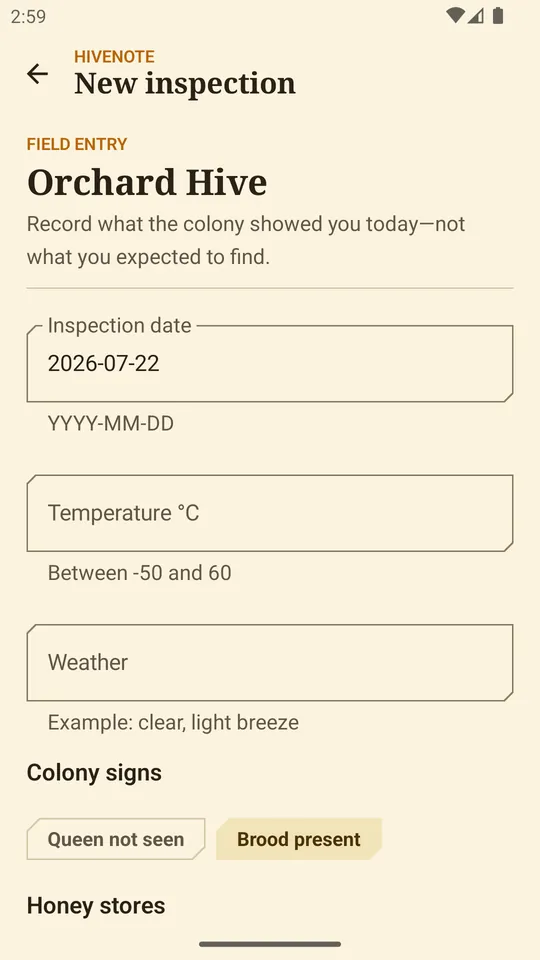
The New inspection screen opens with the hive’s name and a line telling you to record what the colony showed you that day, not what you expected to find. Below it come the date, temperature and weather, then Colony signs, Honey stores, Temperament, pests, actions and notes.
The New inspection screen for Orchard Hive, an example hive in the app’s demo data. The date is filled in; Temperature and Weather are empty; Queen not seen and Brood present are the buttons in Colony signs; the Honey stores heading is cut off at the bottom of the picture.
A timeline for each hive
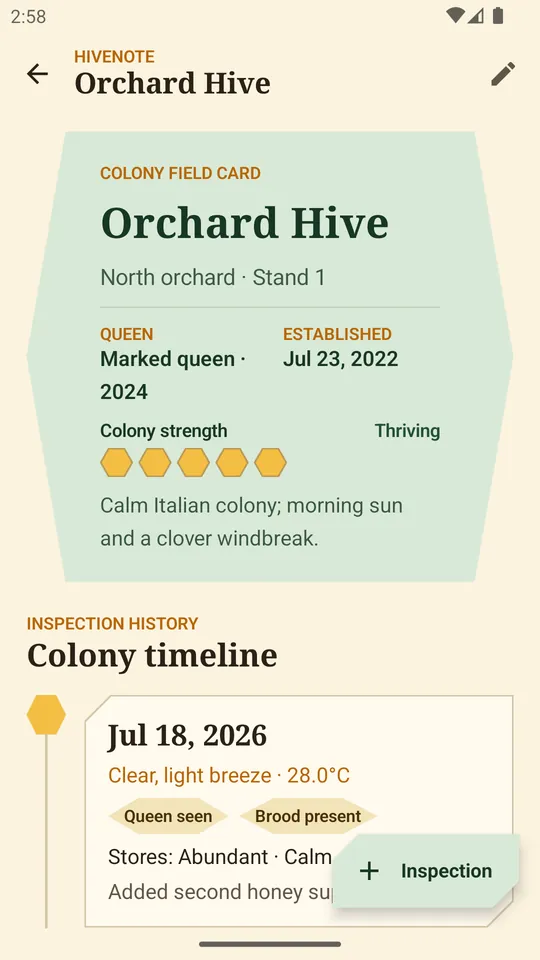
Saved visits appear under Colony timeline, newest first, each with its date, weather and temperature, whether the queen was seen, whether there was brood, and the stores and temperament. Tap a visit to edit it. This is the record USU and Minnesota both ask for, kept on the phone instead of paper. The app does not draw a chart or compare two visits for you; you read down the entries.
The page of Orchard Hive in the app’s demo data: queen status Marked queen 2024, established Jul 23, 2022, colony strength Thriving, a short note, and one timeline entry for Jul 18, 2026 (clear, light breeze, 28.0°C, Queen seen, Brood present, Stores: Abundant, Calm). The Inspection button covers the end of the entry.
A card for every hive, with the date of the last check
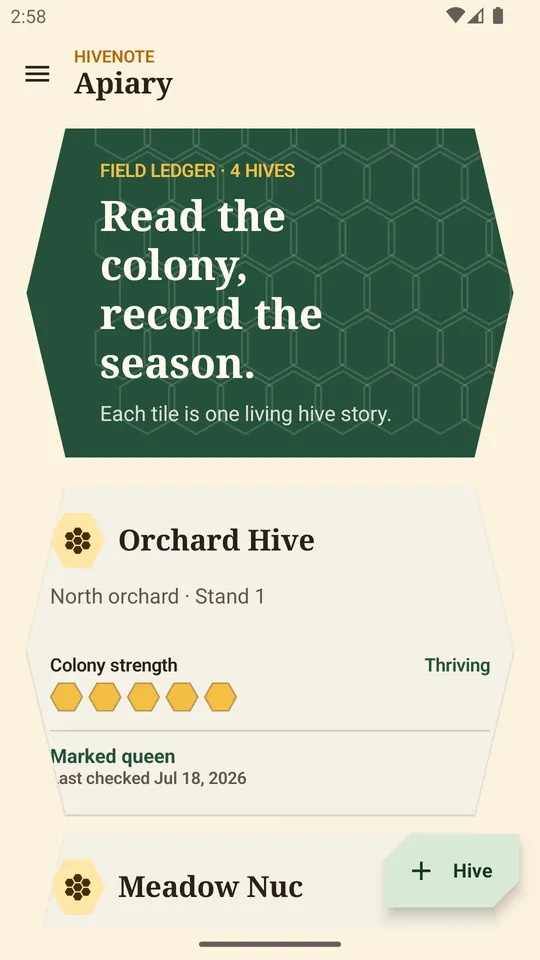
The Apiary screen shows one card per hive with its name, location, colony strength and queen status. Each card says Last checked with the date of its newest inspection, or No inspection yet. The app does not remind you or tell you when the next check is due, so the schedule above stays in your hands.
The Apiary screen with demo data: the header “Read the colony, record the season.” with FIELD LEDGER, 4 HIVES; the Orchard Hive card with Thriving, Marked queen and Last checked Jul 18, 2026; and the top of a second card, Meadow Nuc.
What else is in it
- A hive card with queen status and year, an established date, a colony strength from 1 to 5 and notes.
- A Harvests screen with honey by hive, in kg or frames.
- A Treatments screen for feeding and care records the keeper types in, with a product name and notes.
- A Beekeeper Guide screen with four seasonal cards. I did not check its advice against a source, so this page does not repeat it.
Where it stops
- No checklist, schedule, reminder or alert of its own.
- No field for a brood pattern score, a mite count or the space left in the hive. Those go in notes.
- No photos, no weather lookup, and no way to export or share the journal. Weather and temperature are typed by you.
- It does not find disease or judge a colony. It keeps what you type.
- The store text says it organizes records you enter, and that treatment, handling, disease, allergy and safety decisions belong to product labels and qualified local guidance.
What it keeps, and where
The hives, inspections, harvests and care records you type are kept as one journal in the app’s private storage on your phone, and the app’s menu says “Private journal · stored on this device”. There is no account. Deleting a hive also deletes its inspections, harvests and care records, after a confirmation, and records stay until you delete them, clear the app’s data or uninstall it. One thing leaves the phone: if you use Send feedback in About Developer, your typed message, an optional reply email, and the app and version, Android version and the phone’s maker and model go through an email relay service, Web3Forms, to the developer. The app asks only for the Internet and network state permissions, for that and for links you open. Read the privacy policy.
What I did not check
For this story I read the store listing, the README, the product brief, the data safety and privacy texts, the code and the app’s one test file, and I looked at all six phone pictures in the store folder. That test writes one example journal to text and reads it back equal; I did not run it, and I did not run the app. An older test record is dated before the app became a journal, so I did not count it as a check of this version. I did not check the guide advice against any hive.
View HiveNote on Google PlayUtah State University Extension
Two short articles, both read in full. “How Often Should I Inspect My Beehive?”, dated 09/09/2026, is the source for the checklist, the table, the warning signs and the record list. “What Should I Look for When Inspecting My Beehive?”, dated 09/14/2026, gives the five-things wording and the same advice to write down what you find. Written for Utah.
How often should I inspect my beehive?
What should I look for when inspecting my beehive?
University of Minnesota Bee Lab
“Beekeeping in Northern Climates Workbook”, abbreviated second edition, 2024, funded through USDA NIFA and the North Central Region SARE program, read in full. Used for brood pattern scoring, counting seams of bees, mite monitoring and the sample inspection sheet. Written for northern climates.
Know someone with a hive and a notebook?
Send them the six checks. The record is what makes the next visit easier.