 Saifullah Ahad
How I built it
 VaporSill: Damp PlannerLive on Google Play
VaporSill: how to tell if damp or condensation
How to tell if damp or condensation is forming on your walls: track air moisture, surface temperature, and dew point. VaporSill turns your room readings and outdoor weather context into clear physical evidence. This is how the app models cold surfaces, with its boundaries made clear.
01
Water on the glass. Mold in the corner.
When moisture beads on window glass or black speckles appear on plaster, residents and landlords often get stuck in circular arguments. A standard hygrometer measures the air in the center of the room, but air humidity alone does not explain why water pools on a particular corner.
VaporSill was built to investigate that gap. It pairs room air readings with measured surface temperatures to determine whether moisture is condensing on chilled materials.
02
The physics of the cold surface
Air can only carry so much moisture before it reaches saturation. VaporSill implements the Magnus-Tetens psychrometric formula to calculate vapor pressure, dew point, and absolute humidity in grams per cubic meter.
By comparing measured surface temperature against the dew point, the app calculates the condensation margin in degrees Celsius. The engine flags four clear states: Dryer, Watch (surface relative humidity at or above 70%), Elevated (at or above 80%), and Condensation (margin at or below zero, or surface humidity at 100%).
03
Mapping room isotherms
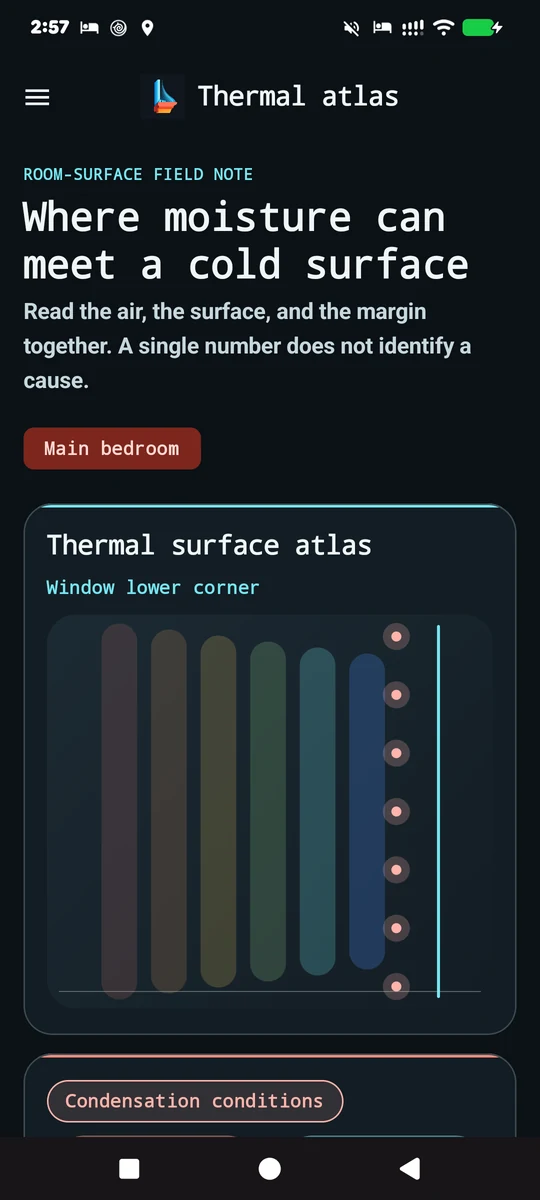
Every room has cooler microclimates: exterior window sills, structural lintels, cold corners, and shadowed walls behind bulky furniture. VaporSill's thermal atlas organizes these readings spatially.
Instead of relying on color alone, every reading displays its numerical temperature, its distance to the condensation threshold, and text status labels. The focus is on verifiable measurements rather than generic humidity scores.
04
Compare outdoor air before opening windows
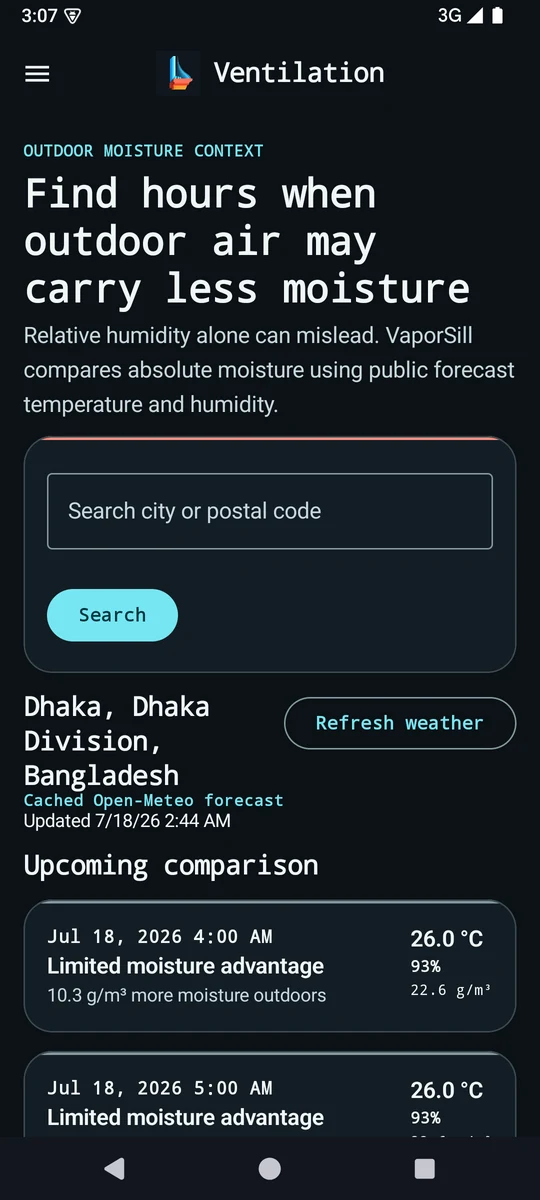
Opening windows only dries a room when outside air carries less absolute moisture than the air inside. If outdoor air is warm and humid, airing out a cool room can actually introduce more moisture onto cold walls.
VaporSill searches public Open-Meteo hourly weather by city or postal code, without requesting device location access. It compares indoor versus outdoor moisture in grams per cubic meter, so residents can see whether outdoor conditions will reduce room humidity.
05
Test solutions in the intervention lab
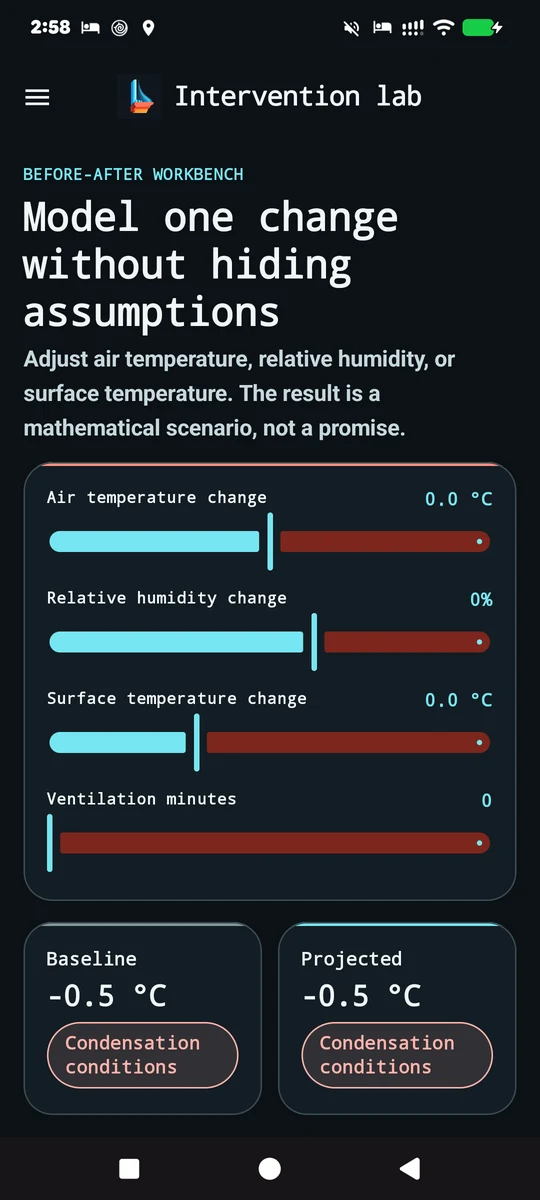
Before buying a dehumidifier, turning up radiators, or applying insulating paint, the intervention lab models what each adjustment would achieve. You can adjust room temperature, humidity, surface warmth, or ventilation time to observe the projected condensation margin.
The simulation models psychrometric shifts alongside your baseline readings without overwriting your original measurements. It projects theoretical margins; it does not promise that a specific habit will fix a building defect.
06
Export a clear record of the evidence
VaporSill exports a paginated PDF case brief or a complete JSON backup using Android's system document picker. All records, room photos, and notes remain stored locally in the app's database on the phone.
The export provides an organized, time-stamped record to bring to a landlord, contractor, or environmental health inspector. The app is a screening and documentation tool, not a certified mold inspection or medical diagnosis.
The design choice
Separate room air moisture from surface cold. Let residents gather dated physical readings and test solutions before negotiating repairs or changing daily habits.
How to tell if damp or condensation
To understand what causes damp or mold on walls, you need to identify where the water comes from. This guidance draws on published advice from Shelter England and the Property Care Association.
- Identify where moisture collects. Condensation on walls happens when moisture generated indoors (from cooking, showers, drying laundry, or breathing) touches cold surfaces like windows, uninsulated external walls, and corners. Penetrating damp enters through exterior building faults like leaking gutters, cracked render, or roof damage. Rising damp affects only ground-floor walls, traveling up from the ground through masonry.
- Examine the stain and mold pattern. Condensation produces water droplets on glass, damp paint surfaces, and speckled black mold, particularly in cold spots and behind wardrobes. Penetrating damp forms localized, distinct damp patches on walls or ceilings that expand and darken during or after heavy rainfall. Rising damp leaves tide marks up to about 1 meter high, peeling baseboards, and white powdery salt deposits (efflorescence); ground salts generally inhibit mold growth.
- Run the ventilation and warmth check. Wipe the surface dry, maintain steady background warmth, and increase ventilation by opening windows or running extractor fans. As Shelter notes, condensation will generally lessen or clear when heating and airflow improve. If a damp patch persists, stays wet in dry air, or worsens with rain regardless of ventilation, moisture is entering through the building fabric or plumbing.
- Compare indoor and outdoor moisture. Condensation peaks in winter when cold exterior walls chill indoor air below its dew point. If moisture spikes right after showers or cooking, indoor humidity is settling on cold spots. If dampness correlates strictly with outdoor rainstorms, external building repairs are needed.
- Keep a dated evidence record. If you rent your home, Shelter recommends notifying your landlord in writing as soon as damp or mold appears. In England, landlords are legally responsible for fixing structural defects, broken heating systems, and inadequate ventilation. Keeping dated photos, room temperature readings, and moisture notes gives you clear documentation.
VaporSill brings room air readings, surface temperatures, and public weather comparisons together on Android to document cold-surface condensation risk over time.
More build stories: How to check a used phone before buying · How to check if your electricity meter is running fast · Eelj: a fair turn for a village’s one harvester · Practicing stuttering techniques at home · Where and when to look for the new crescent moon · How to split electricity bill with roommates · Milk fat SNF rate calculator, step by step · How to check a link before you click it · How to calculate cattle weight without a scale · How to settle who owes who in a group · Braille translator that explains every cell · Math learning gaps: where to start when a child is stuck · How to describe a car noise so a mechanic can find it · Convert Rumi to Jawi, then check the spelling · How to sync SRT subtitles with video · How to measure land area with phone GPS · Quran pronunciation app, tap any word to hear it · Lipi: Bangla keyboard, side by side with Ridmik · How to check an overseas employment contract · Extract data from graph image on Android · Dinig: doorbell alert for deaf
Work with me
Have a problem an app could solve?
Tell me what people need to do, and where the current process fails. You can read more of my work or contact me directly.