 Saifullah Ahad
How I built it
 Lakirawi: Shared Meter SplitLive on Google Play
Lakirawi: how to split electricity bill with roommates
How to split electricity bill with roommates starts with agreeing what a share means: per person, per room, or measured use. Lakirawi tackles a harder version: several households behind one meter, with no separate reading for each family. The part it cannot explain stays on the bill.
01
The problem: one bill is not four explanations
Imagine a person with two lights and a fan sharing a connection with a family that also runs a fridge and a cooler. The bill arrives as one total. Dividing by the number of households is easy; explaining why each household should pay that amount is harder.
This is the situation in Lakirawi’s design brief, not a customer case study. The aim was to make the method visible to everyone sharing the meter, without turning the app into a judge of their habits.
02
The plan: agree on the unexplained part first
The plan supports two to eight households. They list appliances that can be switched safely and agree how to divide energy the app cannot assign: equally, by confidently attributed use, or by household size.
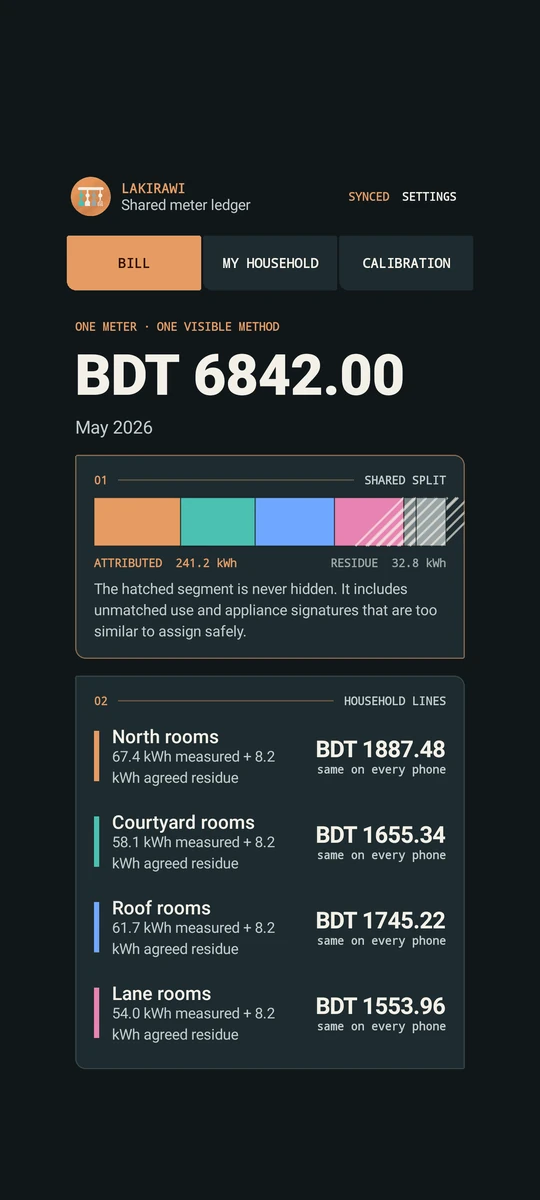
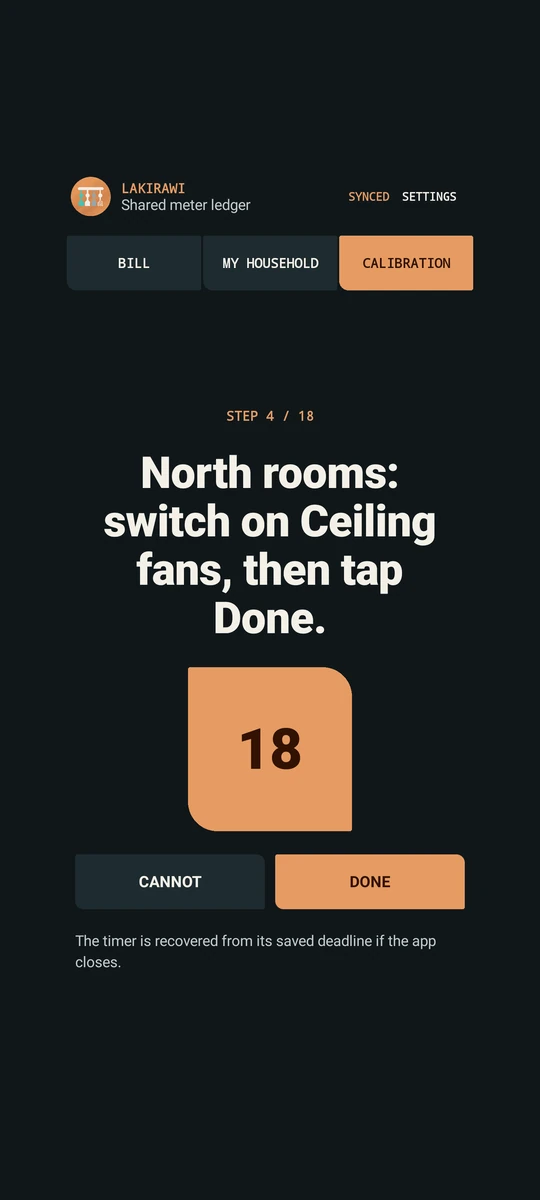
One phone watches the sealed meter’s existing pulse light or rotating-disc mark. The households follow timed appliance instructions. Those changes give the app examples of each appliance’s electrical pattern. Nobody opens, covers or alters the meter, and a person can tap Cannot instead of switching something unsafe.
03
The build: the same working on every phone
AI coding agents built Lakirawi from my written product specification. The rules were as important as the calculation: no household rankings, no hidden leftover, and the same shared numbers for every participant.
The app matches calibrated patterns to later observations. A separate hatched segment shows residue: energy it has not confidently assigned. Allocating that segment by an agreed rule does not turn it into measured household use. Shared updates carry an ordered revision, and the calibration timer uses a saved deadline so closing the app does not restart the clock.
04
What testing had to catch: two fridges looked alike
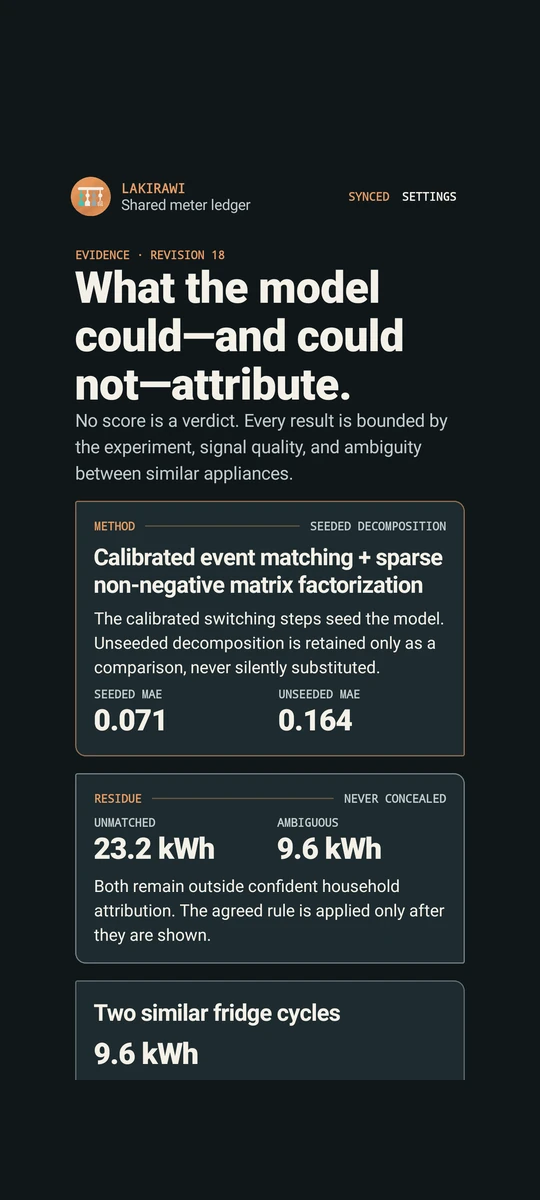
A deliberately difficult test supplied two similar fridge patterns: 180 watts and 192 watts. Then it presented a 186-watt event. Choosing the nearest household would have created an answer the evidence could not support.
The test required no household assignment. It passed with 0.372 kWh kept in one ambiguous group. This was a synthetic test, not a dispute in someone’s home. It is the clearest example of the boundary I wanted: show the uncertainty before applying a sharing rule.
05
What the build checks showed
In a separate synthetic four-household test, a 5 kWh bill left 1 kWh unexplained. The equal residue rule distributed that leftover while preserving the bill’s energy and amount totals.
The build ledger also describes a shared-plan check on an Infinix Note 8 and Galaxy Tab S3. Both displayed BDT 2,000, four BDT 500 rows and a synced state, while keeping their own household identities. That two-device flow used a debug release candidate. A signed-release walkthrough on the Tab S3 covered appliance entry, the switching schedule, camera preview, the Cannot choice and countdown recovery after the app was stopped, with no app fatal exception.
The missing proof matters. The bench had no known-load physical meter rig, so real-meter watt accuracy was not independently measured. No inspected build source documents a trial with real households. Matching test totals and opening a camera preview do not establish either result.
06
Where it stands
Lakirawi: Shared Meter Split is available on Google Play. It offers households a shared method with visible uncertainty. It is not a utility-grade meter, a verdict about a household, or a way to determine or collect debt.
What this shows about how I work
- A total that adds up still needs an explanation of each share.
- An ambiguous appliance stays ambiguous; the app must not invent certainty.
- A synthetic test and a household field trial prove different things.
How to split electricity bill with roommates
Start with the actual bill and an agreement everyone can see. A fair method depends on what you can measure and what you agree to share.
- Fix the period and the people. Check the bill dates, total and whether the reading is estimated. Note readings when someone moves in or out. Shelter Cymru recommends these checks; its advice is written for Wales.
- Equal split: use it when you agree use is similar. Divide the total by the number of people sharing it. Shelter Cymru says “it is a good idea to split the gas and electricity bills equally”. That is a simple starting agreement, not proof that everyone consumed the same amount.
- By room: agree on the unit you are sharing. Divide the total by occupied rooms, then each room’s amount by its occupants. My PG Manager describes its room method exactly: “Each room pays an equal share, which is then divided between the people in that room.” Choose this together; room size alone does not measure electricity use.
- By appliance use: distinguish evidence from an estimate. If a personal heater or air conditioner is the reason for a different share, discuss that adjustment openly. Without a separate measurement, label the adjustment an agreed estimate. Do not present it as exact consumption.
- Sub-meters: use readings from the same dates. Where existing sub-meters measure each room, subtract each starting reading from its ending reading and allocate the usage part by those units. My PG Manager’s method shares common-area use and fixed charges equally between rooms. State your chosen rule separately, use the actual bill total, and check that all shares add up. This is an allocation method, not a universal tenancy rule. Read existing meters only; never open equipment or touch wiring.
How to split electricity bill between tenants when there is only one meter
Keep the agreement and the measurement separate. If you are deciding how to divide electricity bill between roommates, write down who shares the bill, the dates, the chosen method and how common use is handled. Revisit the agreement when occupancy or appliance use changes.
How do you split electric bills between tenants if some use remains unexplained?
Give the unexplained part its own line and agree how to share it. Do not quietly assign it to whichever person seems to use more.
Lakirawi helps households sharing one meter run a cooperative calibration and see both the estimated shares and the uncertainty behind them.
Sources, read October 9, 2026: Shelter Cymru, Energy costs in shared accommodation; My PG Manager, Electricity Bill Split Calculator. The agreement checklist is my synthesis of these methods; it does not establish a tenant’s legal liability.
More build stories: How to check a used phone before buying · How to check if your electricity meter is running fast · Eelj: a fair turn for a village’s one harvester · Practicing stuttering techniques at home · Where and when to look for the new crescent moon · How to check a link before you click it · How to calculate cattle weight without a scale · How to settle who owes who in a group · Math learning gaps: where to start when a child is stuck · How to describe a car noise so a mechanic can find it
Open to work
Let's build your AI product system.
Full-time roles — remote, or on-site anywhere in the world: AI Product Builder, AI Product Manager, AI Workflow Orchestrator, Product Delivery Lead.
Freelance or contract project? Hire me on Upwork or Fiverr.
Based in Dhaka, Bangladesh (UTC+6) · works any time zone · can start now · ready to relocate with visa sponsorship.