Tnixxif: how to dry rice after harvesting
Here is how to dry rice after harvesting, using PHilMech's sun drying guidance and University of Arkansas Extension's explanation of corn drying charts.
From harvest to the next moisture reading
For sun drying paddy rice, these steps follow the Philippine Department of Agriculture's PHilMech Grain Drying manual, printed pages 1, 12, 13, 21 and 23.
Start promptly
PHilMech advises drying as soon as possible after harvest, ideally within 12 hours.
Spread a shallow layer
Use a mat, net, plastic sheet or concrete drying pavement. Spread the paddy 2 to 4 cm deep. Keep animals and other contaminants away.
Turn and protect it
Mix or turn the grain every 30 minutes. PHilMech says plastic sheets or canvas can protect spread paddy from sudden downpours. Monitor grain temperature and moisture while drying.
Measure before storage
Check grain moisture with a moisture meter or an oven test. PHilMech explains that longer storage needs lower moisture content. A count of sunny hours is not a moisture reading.
A forecast beside your measurements
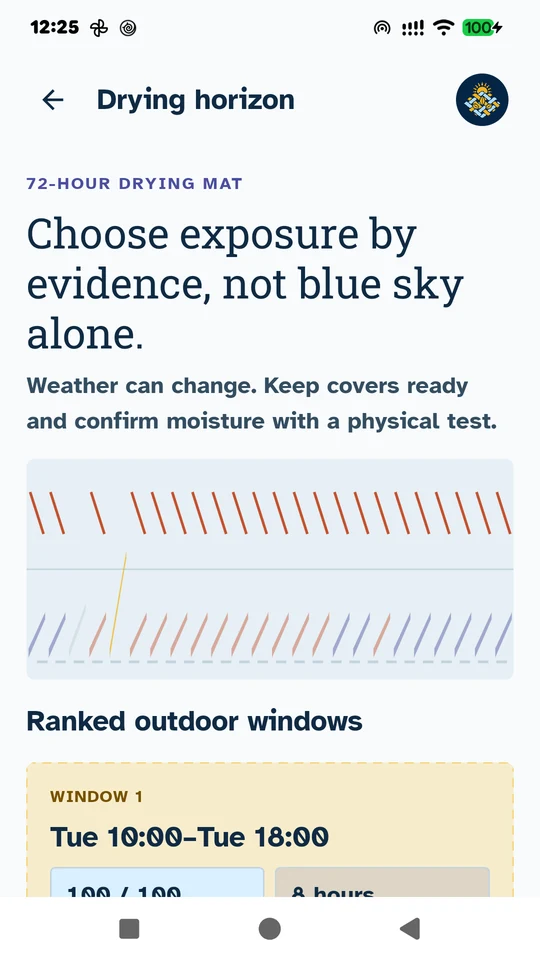
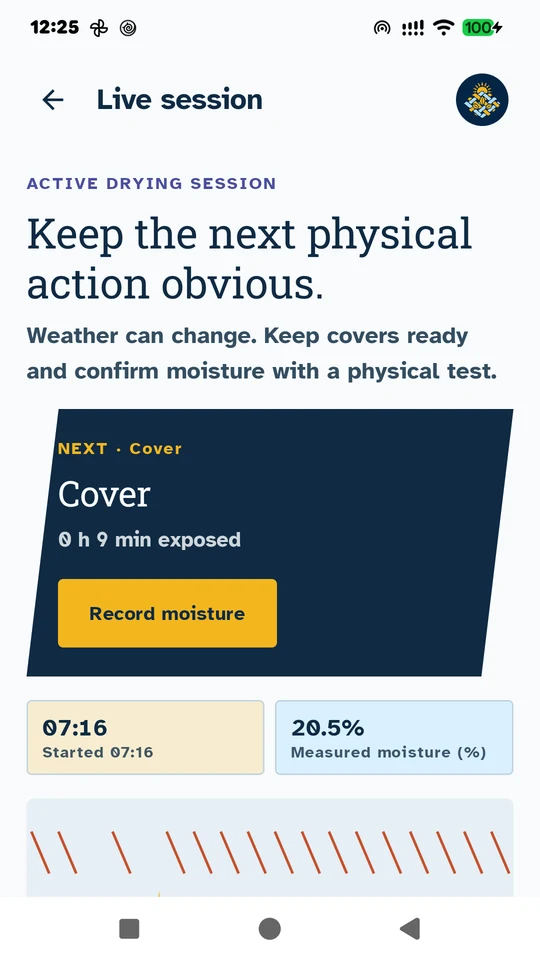
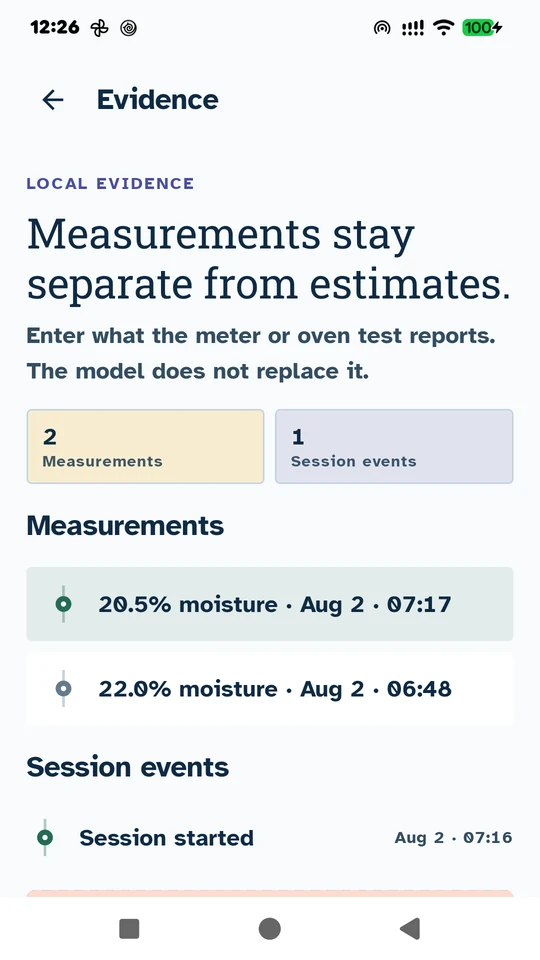
Tnixxif helps plan outdoor drying around a measured batch and an hourly weather forecast. Choose a place, crop, moisture reading and spread details. The Drying horizon ranks windows over 72 hours. Live session shows the next action, while Evidence keeps your readings and session events.
What the plan cannot confirm
A forecast cannot see shade, ground moisture, grain variety, broken kernels or a local shower. Tnixxif uses simplified models and shows estimates with uncertainty. It cannot confirm storage safety or promise that grain will not spoil. Its Model guide calls for local agricultural guidance and a calibrated moisture meter or oven test before storage.
The release notes document checks of the forecast, batch setup, session, readings and saved state. They do not document a farm trial comparing predicted drying with actual grain batches. Those software checks were not repeated for this story.
Before grain reaches the drying mat, Eelj addresses another part of the farm day: arranging the queue for a shared harvester.
More build stories: Ugong: turning a strange engine noise into evidence · Atrekes: a used-phone check the buyer can trust · Simpulan: making loops of debt disappear · Krepusko: finding the new moon on the horizon · LinkScope: see where a link really goes before you open it · Focus & Flow: practicing alone, and knowing you're doing it right · Temelie: where to start when a child is stuck in math · Pwyso: how to calculate cattle weight without a scale · Brojilo: is my electricity meter running fast? How to check · Lakirawi: how to split electricity bill with roommates · TactiGlyph: a braille translator that explains every cell · Lebese: a milk fat SNF rate calculator that shows every step · Jawi Brunei: convert Rumi to Jawi, then check the spelling · SubtitleShift: how to sync SRT subtitles with video · Muganhu: how to measure land area with phone GPS · NUQT: Quran pronunciation app, tap any word to hear it · Lipi: Bangla keyboard for Android, side by side with Ridmik · Baldintza: how to check an overseas employment contract · AxisMend: extract data from graph image on Android · VaporSill: how to tell if damp or condensation · Dinig: doorbell alert for deaf · GlyphFlow: reading apps for dyslexia adults
Have a practical problem an app could help with?
Tell me what people need to do and where the current process gets in their way.
Email Saifullah Explore all twenty-four stories