 Saifullah Ahad
How I built it
 Baldintza: Contract ClausesLive on Google Play
Baldintza: how to check an overseas employment contract
How to check an overseas employment contract before you sign: what the international guidelines for fair recruitment say to look for, step by step. Baldintza is my app, live on Google Play, that photographs the pages, finds each clause and shows where the English and Arabic versions do not say the same thing.
01
The problem
People leaving to work in another country are often handed the contract minutes before signing, in a language they only half read, and told it is the standard one. With one contract in hand, nobody can tell which line is unusual, because no worker gets to see two of them side by side.
In my design brief the example is a made-up cleaner, handed a four-page contract in English and Arabic at the airport, ninety minutes before his flight, with other men waiting behind him.
02
The plan I wrote
The worker photographs every page and checks each picture. The app finds the numbered clauses and matches each one to a plain family, such as working hours, annual leave, passport custody, housing, transport, salary or notice period.
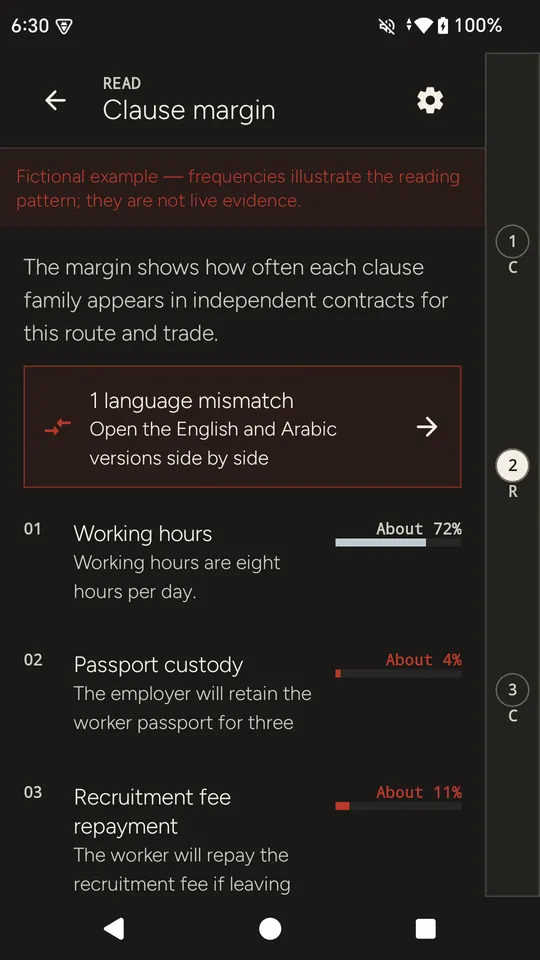
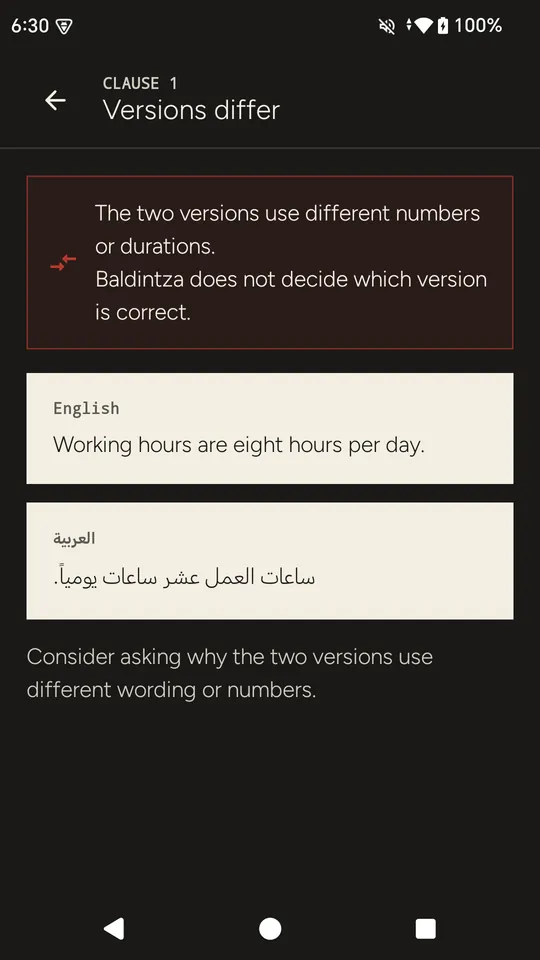
Beside each clause, a bar shows how often that family appears in contracts other workers have shared for the same destination and the same broad kind of work. Where the contract is in English and Arabic, the app lines up the clause numbers, points out where an obligation or a number differs, and shows both versions side by side.
It reports how common a clause is. It never says a clause is legal or illegal, it never names a company or a person, and it never tells anyone whether to sign.
03
The build
AI coding agents built it from my written specification. My part was the plan and its refusals: no legal advice, no names, no page pictures leaving the phone, and the reading works for a worker who shares nothing at all.
04
What can leave the phone
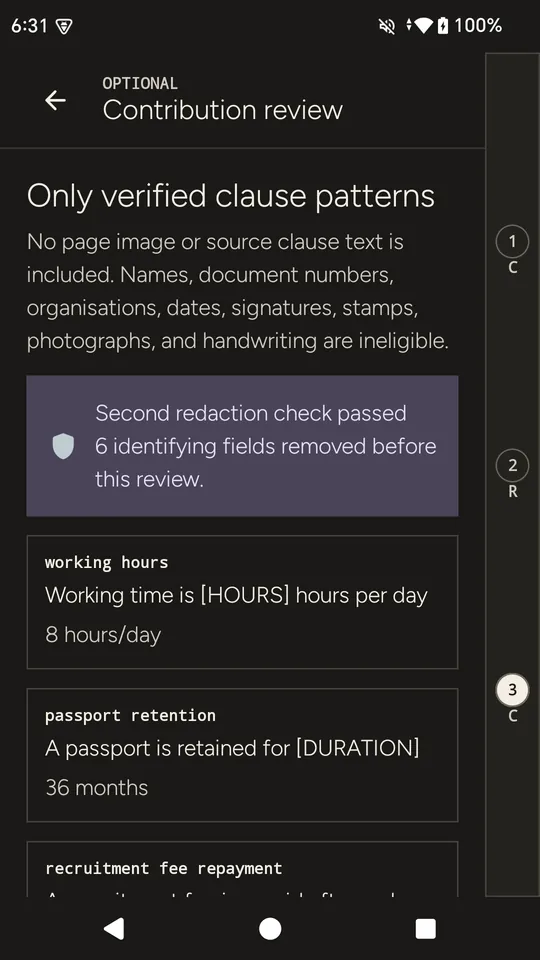
Sharing is optional. A shared clause is only a pattern and its numbers, such as “working time is [HOURS] hours per day” with 8 hours a day. The server accepts no page picture and no clause text.
Before anything is shared, names, document numbers, organizations, dates, signatures, stamps, photographs and handwriting are left out. Then a second check runs over the result. If it is not sure, nothing is sent, the app says so, and the worker still has the reading.
A clause family stays hidden until at least seven different phones have shared it, over at least two days. Until then the margin says “Not enough yet”, with no count. One phone counts once, so a flood of uploads from one phone cannot make a clause look normal: in a test, 50 uploads from one phone moved a visible number by less than one point.
05
What I have checked, and what I have not
Twenty made-up contracts, each with one planted name, one ID number and one employer name: all 60 were removed. That is this test set, not every name a contract can hold.
A test clause that says eight hours in English and ten in Arabic was flagged, and the matching annual-leave clause next to it was left alone. A four-page test contract picture, tilted and shaded, was read on two devices, an Honor Pad X7 tablet and a Galaxy Z Flip4 phone: all 12 numbered clauses were found. The signed release opened 10 screens on both with no crash. With the radios off, a shared item waited, and it was sent when they came back.
What I have not done: the camera has not read a real paper contract yet. On the test devices the cameras were covered, so those reads used a saved page picture. No real contract and no real worker appear in my records. And I cannot see how many workers have shared so far, so on most routes the margin may still say “Not enough yet”.
06
Where it stands
“Baldintza: Contract Clauses” is live on Google Play. It shows how common a clause is and where two language versions differ. It is not legal advice, and it does not tell anyone to sign or not to sign.
If you help workers going abroad and can try it on a real contract, I would like to hear what it gets wrong. Email me.
What this shows about how I work
- A fact a worker can act on, without playing lawyer: how common a clause is, never whether it is legal.
- Nothing shared that could point to a person: names and pictures stay on the phone, and small groups stay hidden.
- Limits stated plainly: tested on made-up contracts and a saved page picture, not yet on paper through the camera.
How to check an overseas employment contract
These steps follow the International Labour Organization’s guidelines for fair recruitment, which cover recruitment within and across borders. They are guidelines, not the law of any one country, and this is not legal advice.
- Get the contract before you leave, in a language you can read. The guidelines say written contracts for migrant workers “should be in a language that the worker can understand” and “should be provided sufficiently in advance of departure from the country of origin”.
- Check where you will work and what you will do. The terms “should inform the workers of the location, requirements and tasks of the job”.
- Read every line about money you pay. “No recruitment fees or related costs should be charged to, or otherwise borne by, workers or jobseekers.” Watch for a line that makes you repay a fee if you leave early.
- Find what it says about your passport. “Workers’ identity documents and contracts should not be confiscated, destroyed or retained.”
- Read how the job can end. Workers “should be free to terminate their employment and, in the case of migrant workers, to return to their country.”
- If it is in two languages, compare the numbers in both. Hours, pay, leave days and the length of the contract should match. If they do not, ask which one applies before you sign.
- Keep your own copy of every page. The guidelines say businesses and public employment services should not interfere with workers’ “free and complete access” to their own documents, “including their employment contracts”. A photo of each page is better than nothing.
- Do not sign under pressure. Workers’ agreements to the terms “should be voluntary and free from deception or coercion.”
Limits. These guidelines are not binding. The rules for your contract depend on your own country and the country you are going to. For your own case, ask your government’s office for workers going abroad, your embassy, or a lawyer.
Baldintza, a contract clause comparison app for workers going abroad, does step 6 for contracts in English and Arabic. Once enough workers on a route have shared, it also shows how common each clause is there, the passport clause included.
Source: International Labour Organization, “General principles and operational guidelines for fair recruitment and definition of recruitment fees and related costs” (2019), general principles 7, 8, 9, 11 and 12 and operational guideline 18.1 (ILO page).
More build stories: How to check a used phone before buying · How to check if your electricity meter is running fast · Eelj: a fair turn for a village’s one harvester · Practicing stuttering techniques at home · Where and when to look for the new crescent moon · How to split electricity bill with roommates · Milk fat SNF rate calculator, step by step · How to check a link before you click it · How to calculate cattle weight without a scale · How to settle who owes who in a group · Braille translator that explains every cell · Math learning gaps: where to start when a child is stuck · How to describe a car noise so a mechanic can find it · Convert Rumi to Jawi, then check the spelling · How to sync SRT subtitles with video · How to measure land area with phone GPS · Quran pronunciation app, tap any word to hear it · Lipi: Bangla keyboard, side by side with Ridmik · Extract data from graph image on Android
Open to work
Let's build your AI product system.
Full-time roles — remote anywhere, hybrid in Bangladesh, or on-site abroad: AI Product Builder, AI Product Manager, AI Workflow Orchestrator, Product Delivery Lead.
Based in Dhaka, Bangladesh (UTC+6) · works any time zone · can start now · ready to relocate with visa sponsorship.