 Saifullah Ahad
 Sigrile: Room HeatLive on Google Play
How to measure room temperature without a thermometer
How to measure room temperature without a thermometer has a short honest answer: I found no way to read an exact number without something that senses the air. What you can do is learn when to check, what number to aim for, and why a phone’s own heat is not the room’s. Sigrile, an Android app, tries a rough estimate from the phone’s battery heat, and this page says where that stops.
What to look for, and when
The World Health Organization (WHO) has a three page sheet for the general public during heat-waves. It does not describe a way to measure without a thermometer. It does say when to check the temperature of a room and what to aim for.
08:00 to 10:00
“Check the room temperature between 08:00 and 10:00, at 13:00 and at night after 22:00.”
13:00
“Ideally, the room temperature should be kept below 32 °C during the day and 24 °C during the night.”
After 22:00
“This is especially important for infants or people who are over 60 years of age or have chronic health conditions.”
“Use the night air to cool down your home. Open all windows and shutters during the night and the early morning, when the outside temperature is lower (if safe to do so).”
“Close windows and shutters (if available) especially those facing the sun during the day.”
WHO, “Information for the general public during heat-waves”. It also says: “THROUGHOUT A HEAT-WAVE, FOLLOW THE RECOMMENDATIONS OF THE LOCAL HEALTH AUTHORITIES” and “Consult your doctor if you feel unusual symptoms or if symptoms persist.”
Two different numbers, so ask which one you mean
The US National Weather Service writes about a second number: “The Heat Index is a measure of how hot it really feels when relative humidity is factored in with the actual air temperature.” This is outdoor weather information, but it shows why one number is not enough.
The Weather Service’s own example
| Air temperature | 96 °F |
|---|---|
| Relative humidity | 65% |
| Heat index, how hot it feels | 121 °F |
From the Weather Service’s Heat Forecast Tools page, not from Sigrile.
The same page says: “Since heat index values were devised for shady, light wind conditions, exposure to full sunshine can increase heat index values by up to 15 °F.”
My reading, not the source’s: a room is a different place from the outdoors, and neither source tells you to judge a room by touch. Sigrile does not measure humidity at all, so whatever it shows is about temperature only.
Sources: WHO, Information for the general public during heat-waves (PDF, no date printed on it). US National Weather Service, Heat Forecast Tools (no date shown). Both read in full.
How to measure room temperature with a phone without a thermometer
A phone can seem like the answer, and it is the catch behind this whole search. The battery temperature an app can read is not the temperature of the air. Sigrile says so itself, on its About and sources screen: “Battery temperature follows room air slowly and also includes the phone’s own heat. Sigrile identifies those dynamics instead of pretending the sensor is already a room thermometer.”
What it reads
Every sample records the battery temperature, the battery level, whether the phone is plugged in and the charge current, whether the screen is on, a short reading of how much the phone moved, and the light level if the phone has a light sensor.
I checked in the code: it does not read an air temperature sensor.
How it handles the phone’s own heat
It labels each sample by the phone’s state: idle, charging slowly, charging fast, full and topped up, or screen on. Only samples with the screen off, the phone still and the room dark count as usable. It then works over the whole finished night with an assumed delay for the phone to follow the air, and draws a band that gets thicker where it is less sure.
When it will not answer
It refuses, in plain words, instead of showing a number. The refusal lines in the app include “The phone moved too often to describe this night.”, “Charging and screen changes interrupted too much of the night.” and “The estimate is too uncertain to say.”
What Sigrile: Room Heat shows
Sigrile is an Android app you leave still by the bed overnight. Its footer on every screen says: “Sigrile is an uncertainty-aware household estimate, not a certified thermometer or safety alarm.” The name in the Play store and in the app is Sigrile.
Morning: one sentence and a band
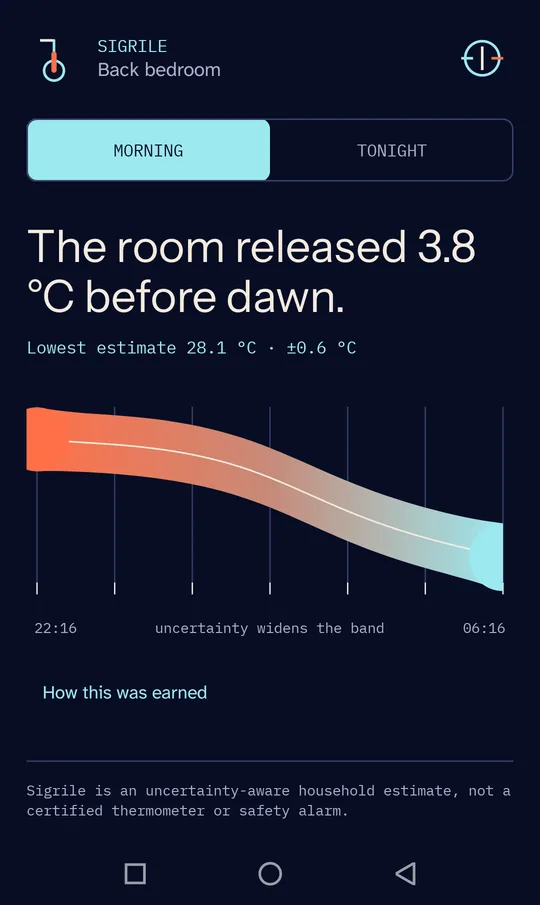
The MORNING tab gives a sentence such as “The room released N before dawn.” If the night changed by less than 0.4 degrees it says “The room held nearly all of yesterday’s heat.” Under it is either “Lowest estimate” with a margin, or “Relative change only · absolute temperature is still being learned”. How this was earned opens the evidence, including the line “WHO heat-wave context: ideally below 24 °C at night”.
The Morning screen from the store pictures: the room is named Back bedroom, the sentence reads 3.8 degrees, and the band runs from 22:16 to 06:16.
Tonight: only with a forecast
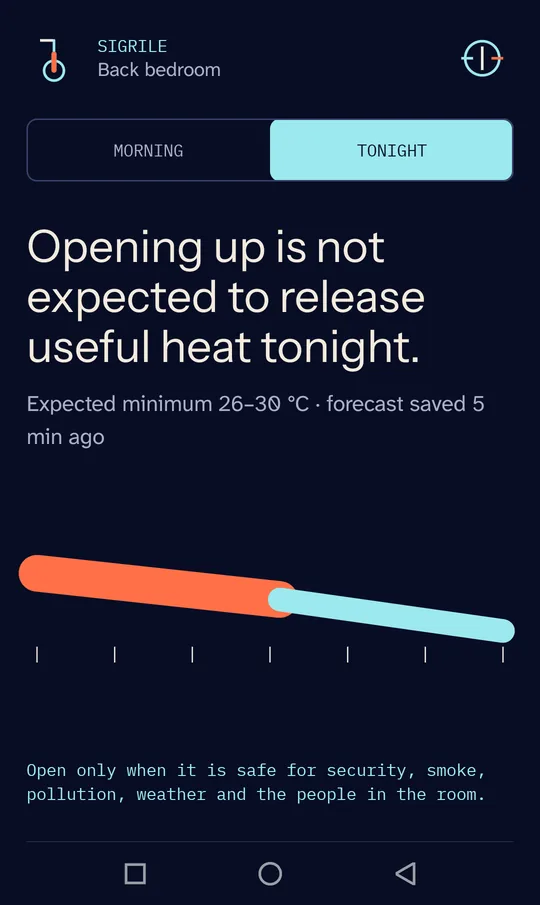
The TONIGHT tab needs a town or city typed in setup (optional) and a forecast saved in the last 12 hours. Without one it says “Tonight’s forecast is missing or stale.” and “Sigrile will not invent an opening hour.” With one it says either “Opening up is likely to help from about” a time, or “Opening up is not expected to release useful heat tonight.” Its own caution line: “Open only when it is safe for security, smoke, pollution, weather and the people in the room.” That matches the WHO wording “if safe to do so”. The forecast comes from the Open-Meteo service.
The Tonight screen from the store pictures: the sentence says opening up is not expected to help, with an expected minimum of 26 to 30 °C, and the safety line below the band.
How a night goes
- In setup you give a room name. A town or city, a person label and a calibration night are optional. The button is Start listening tonight.
- The app says: “Leave the phone unplugged, screen off and uncovered by the bed. The first honest answer needs at least three hours and 18 samples.” It takes a sample about every 10 minutes between 20:00 and 08:00.
- If the night is unusable, the app says: “Try again tonight: set the phone on a hard open surface, leave it still, and keep the screen off.”
Where it stops
- Without an anchor it reports change only. The Calibration screen lists the anchors: a real ambient sensor on the phone, an opt-in sheltered night beside outdoor air, a calibrated second phone, an anonymous prior for the phone model, or “No anchor: Sigrile reports relative cooling and says so.”
- From the code I read, a phone starts with no anchor. I found no code in the shipped app that sets one, so I could confirm only the change-only result. The store pictures show a lowest estimate with an anchor line, and I could not confirm from the code how a phone gets to that screen. The project records say the same kind of thing: hardware calibration was left for a later version.
- The Tonight forecast uses fixed room numbers, not numbers measured from your room.
- It is not a medical device or a safety alarm. For symptoms, see a doctor, as WHO says.
What it keeps, and where
The night samples, room name, optional person label and town or city, coarse coordinates rounded to 0.25 degrees, and results are kept in a private database on the phone. Android backup is turned off. The privacy policy says the app requests no Android location permission. Clearing the app’s storage or uninstalling removes the local records, and Privacy and data then Delete my Sigrile data deletes the rest.
Some features use the internet and are optional: the town or city text goes to Open-Meteo to find coordinates, you can share one morning sentence with one trusted person using a code, and an anonymous comparison with nearby rooms is off until you opt in. There is no account.
What I did not check
I read the store listing, project records, the code and the text in it, the privacy policy, and I opened the store pictures. I did not run the app. I ran none of its tests. The records show a walk-through on a phone of setup, pairing, deletion and a first-night refusal, and say a full unplugged night on real hardware was not measured. I have no result for how close any number is to a real thermometer, so this page gives none.
Get it
An Android app on Google Play, for a rough overnight picture of one room.
View Sigrile on Google PlayWorld Health Organization
“Information for the general public during heat-waves”, a three page PDF with no date printed on it. Read in full. The Sigrile app links this same sheet as its night context.
who.int: Information for the general public during heat-waves
US National Weather Service
“Heat Forecast Tools”, in the Safety section of weather.gov, no date shown. Read in full. It is about outdoor weather, and I use only its heat index explanation.
Is your room hot at night?
Start with the WHO times and numbers above, and ask your local health authority when in doubt.