 Saifullah Ahad
 RoomDocketLive on Google Play
Move out inspection checklist for tenant
Here is a move out inspection checklist for tenant use, built from two named sources: a county housing agency in Maryland, USA, and a charity in England. After the checklist, one short part on RoomDocket, an Android app that keeps a room by room record on your phone.
This is not legal advice. Deposit rules differ by country, state and city, and the two sources below describe two places only. Where you live, check the rules of your own place.
Moving out of my apartment checklist: before, on the day, after
Each line says which place it comes from. MD is the Montgomery County, Maryland housing agency (state law as that county describes it). EN is Shelter, a charity, writing about England. Quotation marks mean the source’s own words.
Phase 1Before the day
- Ask for the final walkthrough in writing. To require the landlord to be present, the county page says to send written notice by certified mail at least 15 days before your move-out date, with the date and your new address. MD
- If an agent offers a pre check out inspection: “It gives you a chance to fix any damage or replace any missing items before your final check out inspection.” EN
- Get the property ready. Shelter’s list: replace any missing or broken items; fix any damage you caused if you can; clean the property so that it is the same as when you moved in; make sure the garden is like it was when you moved in; remove rubbish that does not fit into your wheelie bins. EN
- Find your move-in record. “It is harder for them to charge you for things like cleaning or damage if there is no proof of how the property was when you moved in.” EN
Phase 2On the day
- Go round the property with the landlord or agent: “check the property and inventory together”. “You cannot be charged fees for inspections or inventories.” EN
- Take photographs as part of the inspection: the county page recommends “time and date stamped photographs of the rental property”. MD
- “Make your own inventory. Take a video of the property on the day you move out.” EN
- “Make sure they write down anything you do not agree with.” EN
- “Prepare an inspection report even if no damage is noted. The inspection report should be signed by both parties”. MD
Phase 3After the keys go back
- If the inspection happens after you leave, Shelter says: “This is not illegal but it can lead to disputes and delays in getting your deposit back.” That is why it asks you to make your own inventory. EN
- If the landlord withholds any of the deposit, the county page says a written notice of the deductions must come “within 45 days from the end of the tenancy”, with “a written list of the damages claimed and a statement of the costs actually incurred”. MD
- Shelter says a check out inspection and inventory show what the property is like when you give it back, and: “The deposit protection scheme look at this evidence if you use their dispute process.” EN
- The county page: “The most common dispute between landlords and tenants involves the refund of the tenant’s security deposit after the end of the tenancy.” MD
The 15 days, the 5 days and the 45 days are Maryland numbers from the county page. Shelter gives no such numbers on the page I read, and I give none for any other place.
Should I be present for the move out inspection?
Both sources say yes, in different words, and they differ on how you arrange it.
Montgomery County, Maryland
A county housing agency (DHCA). It describes Maryland state law.
- It “strongly recommends that both the landlord and the tenant inspect the rental property prior to move-in and at move-out to compile a written list of any damages.”
- “State law specifies procedures that the tenant must follow to arrange for a final walkthrough inspection.” The tenant sends written notice by certified mail at least 15 days before the move-out date, with the move-out date and the new address.
- The landlord must reply in writing by certified mail with a date and time, and must “Schedule the inspection within 5 days before, or 5 days after, the move-out date given by the tenant.”
England
Shelter, a registered charity, page “Check out inspections”, last updated 9 May 2024.
- “Ask them for a time when you can be there to: let your landlord or agent in; check the property and inventory together.”
- If you are not there, “You do not get a chance to say you disagree with things until you get a copy of the check out report.”
- If you have a joint tenancy, “it is a good idea for all the joint tenants to be there.”
Damage, or normal wear and tear?
The county page defines it: “Ordinary wear and tear is deterioration that occurs without negligence, carelessness or abuse of the premises, equipment, furnishings or appliances by the tenant, a member of the household or other persons on the premises with the tenant’s consent.”
Its example: “faded, cracked or chipped paint is ordinary wear and tear.” That is Maryland’s wording as the county gives it. Other places may define it differently, so a note on a check, such as what a mark looks like and where it is, is more useful than a word like “bad”.
Example only: the Maryland numbers on a calendar
- June 15 or earlier
Written notice by certified mail, with the move-out date and your new address (at least 15 days before June 30).
- June 25 to July 5
The window for the landlord to hold the inspection: 5 days before to 5 days after the date you gave.
- June 30
The move-out date in this example, and the end of the tenancy.
- August 14
45 days after June 30: when a written list of deductions would be due, if the landlord withholds any of the deposit.
I worked these dates out from the numbers on the county page, using June 30 as an invented move-out date. This is an example, not a rule for where you live, and not advice on any real tenancy.
How RoomDocket keeps the walkthrough
RoomDocket: Rental Record is an Android app for one rented property at a time. You walk through each room, mark a condition for each check, add a note and a photo, and later compare a move-in record with a move-out record or save a PDF. It is a note-keeping tool. It does not tell you what the law says or whether a deduction is fair.
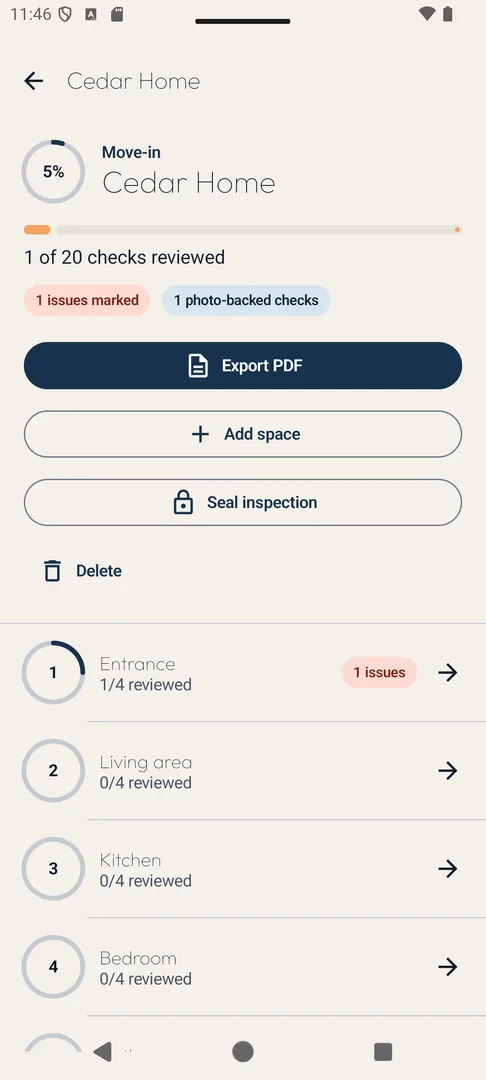
Set up the rooms
New inspection asks for a Property name, an Address or reference and an Inspection phase: Move-in, Move-out or Periodic. It starts with five spaces of four checks each: Entrance, Living area, Kitchen, Bedroom and Bathroom. Add space and Add check let you change that.
A demo inspection named Cedar Home: Move-in, 1 of 20 checks reviewed, and the first four spaces.
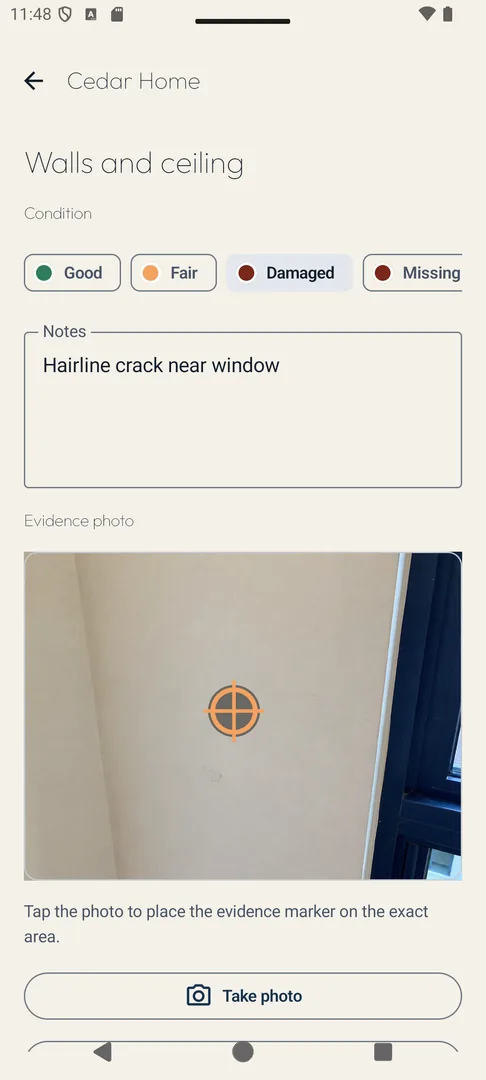
Mark one check
Each check takes one condition: Good, Fair, Damaged, Missing or Not reviewed, plus Notes and an Evidence photo. Take photo opens the phone’s own camera app; Choose photo uses Android’s picker. The app’s line: “Tap the photo to place the evidence marker on the exact area.”
The Walls and ceiling check in the demo: Damaged, a note, and a wall photo with the marker placed by hand.
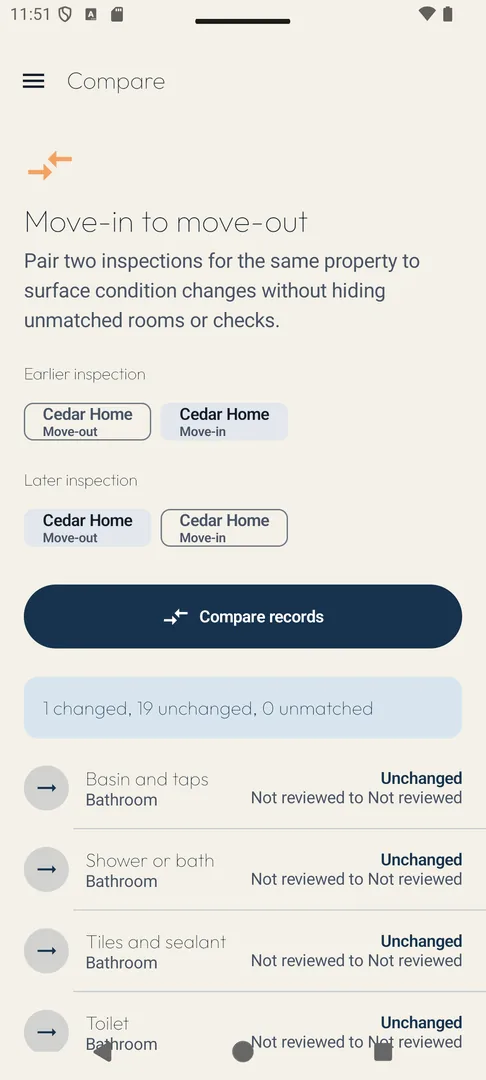
Compare two records
On Compare you pick an Earlier inspection and a Later inspection and press Compare records. The app says it pairs two inspections “without hiding unmatched rooms or checks”. Rows read Worsened, Improved, Unchanged, Only in later record or Only in earlier record.
The Compare screen with the demo records: the result line and the first rows, which here read Unchanged, Not reviewed to Not reviewed.
- Seal inspection
- The app says: “Sealing marks the current walkthrough as ready to export. You can still reopen and edit it later.” It is a label inside the app. It does not sign or lock anything.
- Export PDF
- Saves a PDF to a place you choose. It holds the property name, the address or reference you typed, the phase, the date created, a review summary, then each space and check with its condition, note, a small copy of the photo and the marker. Its last line says: “Review the report before sharing.”
- Delete
- The app asks: “Delete this inspection and its local evidence? This cannot be undone.” A PDF you saved elsewhere stays where you saved it.
Where it stops
- It is not legal advice. The project’s own notes say a report is an organized record, not legal certification and not an official inspection.
- I make no claim that a landlord, a deposit scheme or a court will accept a RoomDocket photo, PDF or record. That depends on where you live and on them.
- The marker only points at a spot on one photo. The app does not find damage by itself.
- Comparison matches checks by room name and check name. If you rename a room or a check between the two inspections, it shows up as two unmatched rows.
- The starter list is the same for every phase. It is not a lease or an official form.
- Records stay on one phone. No account, no sync between phones.
What it keeps, and where
The privacy policy says the app keeps property names or references, phases, dates, rooms, conditions, notes, photo references and markers in its private local database and app-controlled files on the phone. It says the app asks for no runtime permissions, and that data leaves only through something you do, such as saving a PDF. Delete an inspection, clear the app’s storage or uninstall and the records go; saved PDFs do not.
What I did not check
I read the store listing, the project notes, the code and its text, the privacy policy and the store pictures. I did not run the app. I ran none of its tests and found no test result in its records, so I cannot say how it behaves on a particular phone. I did not open its sample PDF or inspect the signed release’s merged manifest. I read the two guide pages once, on November 13, 2026; the county page shows no date, and neither page covers any place beyond Maryland and England.
Montgomery County, Maryland: Department of Housing and Community Affairs
“Security Deposits and Move-In, Move-Out Inspections”. A county government page. It shows no publication date. Read in full. Its sections on deposit interest and surety bonds are not used here.
montgomerycountymd.gov: Security Deposits and Move-In, Move-Out Inspections
Shelter England
“Check out inspections”, from the series “How to get your deposit back”, last updated 9 May 2024. Shelter’s own page footer gives it as a registered charity. Read in full. It is about England.
Moving out soon?
Start with the lines above for your own place, and ask your landlord or agent what the rules are where you live.