 Saifullah Ahad
 GounidLive on Google Play
How much do delivery drivers make? It depends on who is counted and what comes off
How much do delivery drivers make depends on whose pay is counted and on what is taken off it. This page gives no average pay for anyone. It shows what a US government source reports and whom it leaves out, what a University of California study says about costs, and how Gounid, an Android app, lets a rider see what is kept after costs from the rider’s own screenshots.
An example sum, not real pay
Invented numbers in plain units, with no currency. They show the arithmetic only.
- Shown by the delivery app for the day
- 100
- Fuel
- − 30
- Vehicle rent
- − 20
- Phone data
- − 5
- Kept
- 45
Over 6 hours from first start to last stop, the app’s 100 reads as 16.7 an hour and the 45 kept reads as 7.5 an hour. The hours include the waiting between orders.
Delivery driver earnings in one government source: the figure and its edges
The U.S. Bureau of Labor Statistics keeps an Occupational Outlook Handbook. Its page for Delivery Truck Drivers and Driver/Sales Workers says “Last modified date: August 27, 2026”. Here is what it shows, with what it leaves out.
BLS, United States, 2025 median pay
$43,950 per year$21.13 per hour
Of the median, the page says: “The wage at which half of the workers in the occupation earned more than that amount and half earned less.”
Who is not in it
“It does not include pay for self-employed workers, agriculture workers, or workers in private households”.
So these figures do not tell a self-employed rider what he keeps. They also cover one occupation in one country.
The same page says: “Within every occupation, earnings vary by experience, responsibility, performance, tenure, and geographic area.” It also says: “Some drivers/sales workers, such as pizza delivery workers, receive tips in addition to hourly wages.” I did not find the page saying whether the median above includes tips. These are the page’s figures, not mine, and I add no other pay number on this page.
Delivery rider earnings: what a pay screen does not subtract
A University of California, Berkeley study of gig passenger and delivery drivers in five US metro areas (May 2024) is about exactly this gap. I print none of its pay results here, so go to the paper for those. These are its points about method, in its words.
The whole shift
“One key measure is earnings, after expenses, over a driver’s entire shift.”
The unit is the shift, not only the minutes with an order.
Which costs count
“Gig companies argue that only variable costs (that is, the operating costs) should determine drivers’ expenses”
The study chose a wider count of vehicle costs, and says so. The two sides disagree, so a figure always depends on this choice.
Thin data
“… the absence of systematic data on drivers’ working time, earnings, tips, and expenses.”
The authors name this as why they did the study.
Their abstract adds that policy rules for gig drivers’ pay have been “hampered” by that missing data. The study covers 52,370 trips by 1,088 drivers on six platforms. It is not about your city.
Source: Ken Jacobs, Michael Reich, Tynan Challenor and Aida Farmand, “Gig Passenger and Delivery Driver Pay in Five Metro Areas”, Institute for Research on Labor and Employment, University of California, Berkeley, May 2024.
Before you trust any pay figure, three things to write down
- Who is counted. The BLS says its pay data leave out the self-employed. A figure for employees is not a figure for you if you are not one.
- How many hours. The Berkeley study measures over “a driver’s entire shift”. Count from when you start until you stop, waiting included.
- Which costs, and the rule you picked. Researchers and companies disagree on which vehicle costs count. Choose a rule, write it down and keep it, so this week can be compared with last week.
What Gounid shows a rider
Gounid: Rider Earnings Tracker is an Android app for delivery riders and gig drivers. It works from what the rider records and shares, and it makes no promise of more money. It shows what is kept after fuel and the standing costs the rider enters.
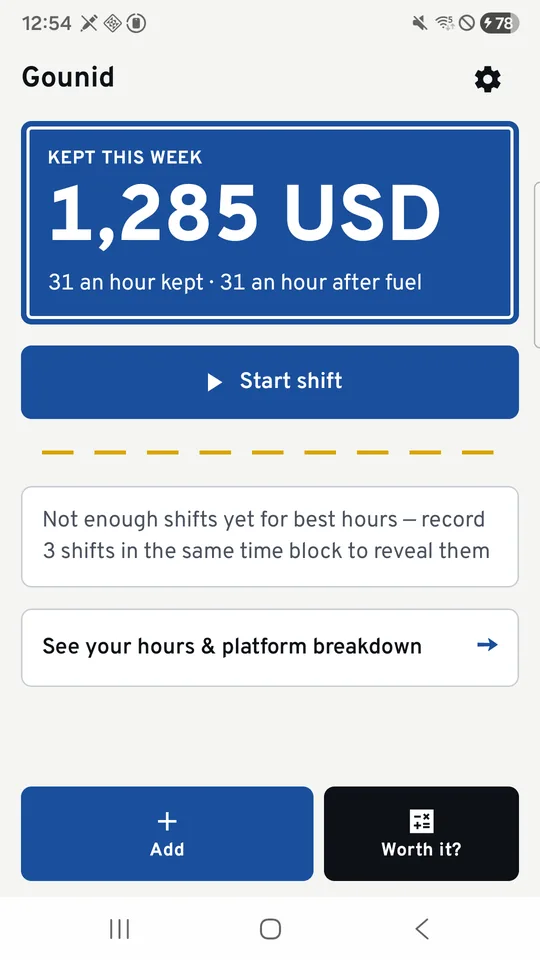
This week
The home screen shows a plate with the caption KEPT THIS WEEK and a line that reads “an hour kept” and “an hour after fuel”. Start shift begins a shift and becomes End shift with the elapsed time. Where there is too little data it says so: “Not enough shifts yet for best hours”.
The home screen with example numbers entered for the store picture. The numbers are not printed here.
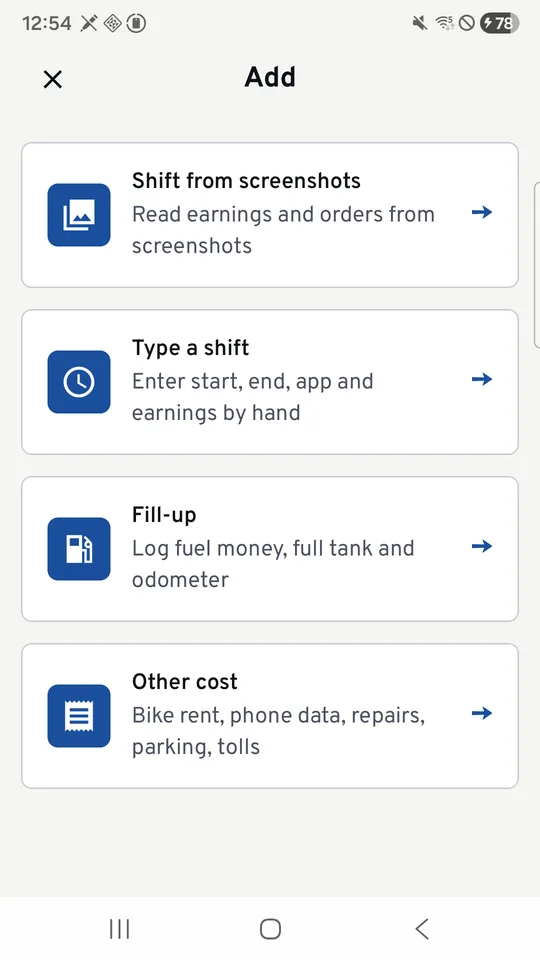
Four ways to add
Shift from screenshots reads earnings and orders from screenshots you share. Type a shift takes start, end, app and earnings by hand. Fill-up logs fuel money, full tank and odometer. Other cost covers bike rent, phone data, repairs, parking and tolls.
The Add screen with its four choices.
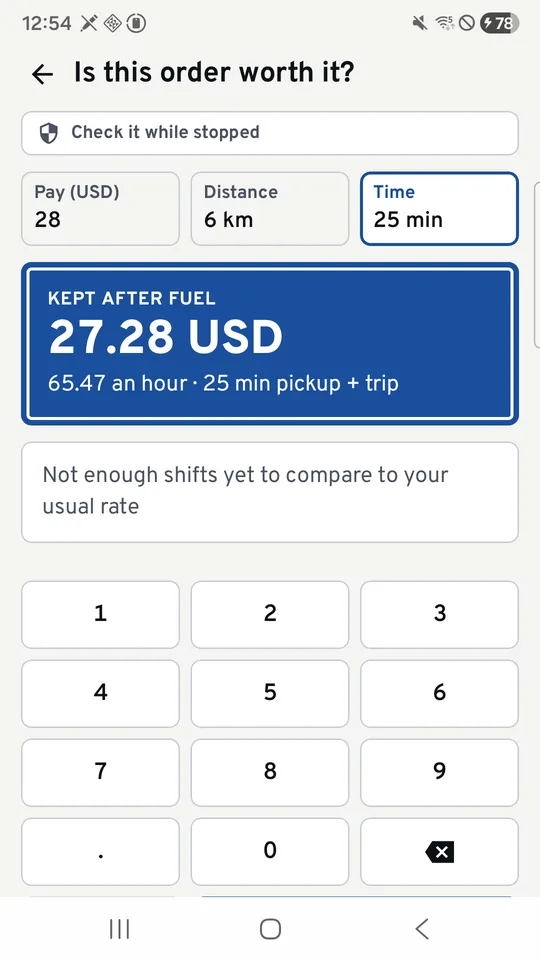
Is this order worth it?
You enter Pay, Distance and Time for an offer. A plate labeled KEPT AFTER FUEL gives an hourly line for pickup plus trip. Once there are enough shifts it compares with “Your usual”; before that it says “Not enough shifts yet to compare to your usual rate”. The screen opens with “Check it while stopped”.
The order check with example entries. The numbers are not printed here.
Reading screenshots, and the checks before anything is saved
- Share Earnings summaries or order receipts shared to Gounid from another app, one or several images.
- Confirm The Confirm screen says: “Tap a value to check or correct it. Missing distance and working time must be entered before saving.” Doubtful values carry a Check this badge, and saving is blocked while any remain: “Check highlighted fields first”.
- Hours It asks for the working time in a form such as 4h 30m and says to use “the full working time, not only active delivery time”.
- Costs Setup holds Fixed costs, a Fuel cost per km (first guess), and an optional Repair reserve: “Reserve money per km for tires, chains and oil”. Fill-ups feed the fuel cost per km.
- Patterns Insights shows hour-of-week pay rates and a usual rate that needs “at least 5 shifts in the last 28 days”.
Where it stops
- The store text says screenshot reading “can be incomplete or wrong”. Check each value against the original image and enter an unfamiliar layout by hand.
- It shows what you recorded. It cannot say what any rider in your city makes, and it states no pay for anyone.
- The unit it works in is your own records. It says “not enough shifts yet” instead of guessing from a few.
- It gives no tax or legal advice.
- No account, and no location tracking in its records.
What it keeps, and what leaves the phone
Shifts, fill-ups, costs and settings are kept in an encrypted journal on the phone. The privacy policy says the app “sends no data off your device” and that the developer “operates no server or backend database for this app”.
For screenshots it says: “images are decoded and processed in memory only using on-device text recognition provided by Google Play services.” and that Gounid “never saves screenshot images to local files, cache, or the journal”. So no screenshot is sent anywhere by the app. The store text says Google Play services may need to download its text model before the first read. The project records also mention a cloud job: that was a cloud coding session for test work on the project, not a feature of the app.
The only way data leaves is a CSV export that you start and place yourself. The manifest removes internet, network state and Wi-Fi state, and declares one permission, the biometric one for the optional App lock. Delete all data in Setup erases the records.
What I did not check
I read the store listing, the project records, the code and the text in it, the privacy policy, and opened the store pictures. I did not run the app myself. The upload record says it was walked through on a phone and a tablet, and I did not repeat that. I found no figure for how often screenshot reading is right, so this page gives none. I did not inspect the signed release’s merged manifest. I read the BLS page through a page-reading tool because its site refused my script, so check the figures on the page itself.
Get it
An Android app on Google Play. It shows a rider what is kept after costs.
View Gounid on Google PlayU.S. Bureau of Labor Statistics
Occupational Outlook Handbook, “Delivery Truck Drivers and Driver/Sales Workers”, last modified August 27, 2026. Quick Facts, 2025 median pay. A government statistics agency.
University of California, Berkeley
“Gig Passenger and Delivery Driver Pay in Five Metro Areas”, Jacobs, Reich, Challenor and Farmand, May 2024. Abstract and expenses section read. Its pay results are not repeated here.
escholarship.org: Gig Passenger and Delivery Driver Pay in Five Metro Areas
Working out what you keep?
Start with the three lines above: who is counted, how many hours, which costs.