 Saifullah Ahad
 DopokazLive on Google Play
Cash register short: count the drawer again, then compare the records
Cash register short at closing? The first job is a clean count, not a conclusion. Two university cash offices describe how they count a drawer and reconcile it, and you can follow the same steps with no app. Dopokaz, an Android app that lists the explanations your entered records still allow, comes after.
What to do first when the till is short
Utah State University’s Controller’s Office writes cash handling procedures for its own departments. These are its counting steps, quoted as it writes them. They are one university’s rules, not a rule for every shop.
-
Count at the start of the shift
“Each Cashier must count the money in his or her cash register at the beginning of his or her shift.”
-
Count at the end, away from the crowd
“Each Cashier should count the register at the end of his or her shift. Count cash in a secure location.”
“Do not count cash in the presence of customers or other employees not involved in the handling of cash.”
-
Count before you see the total
The procedures call this blind balancing.
“Blind balancing means the Cashier balances their till without knowing the correct totals in advance.”
“The Cashier counts the drawer to its beginning amount without access to the ‘X’ or ‘Z’ or journal tapes.”
-
If the numbers differ, count again
“If there is a variance, the Cashier recounts the drawer.”
-
No register? Keep the receipts
“If not using a cash register, log the sales and keep copies of receipts. Balance cash against those receipts.”
Source: Utah State University Controller’s Office, “Cash Handling Procedures”. The page shows no date. Read in full on 2026-11-13. I left out its parts on incident reports, dollar limits and reviews, because this page does not judge any person.
Then write the count down and compare it to the register report
Ohio University’s Office of the Bursar asks for a worksheet at each count:
“Cash drawers and cash registers should be counted down before and after each shift and a worksheet should be completed.”
The count is then set against the register’s own report, and a difference is not left unwritten:
“The physical count of cash, checks, and credit card should be reconciled to the cash register or point-of-sale system report, multiple-copy receipt book or manual cash receipts journal, whichever is applicable. Any overages or shortages should be indicated on the worksheet and investigated.”
It also asks that “The reason for any significant or repetitive overages/shortages should be documented and retained with the reconciliation.”
Source: Ohio University Office of the Bursar, “Cash Handling Guidelines”. The page shows no date. Read in full on 2026-11-13. These are the university’s guidelines for its own departments.
Ohio worksheet lines
- Beginning of day (or shift) balance (if applicable)
- Plus Cash received during the day (or shift)
- Plus Checks received during the day (or shift)
- Less Standard amount kept on-hand (if applicable)
- Equals Deposit amount
- Physical count of the cash, by denomination
- Reconcile to the register or point-of-sale report
Lines as the guidelines list them. The guidelines also have a line for card payments, which I left out of this shortened copy.
Why one short total can hide more than one explanation
This is the fictional case built into Dopokaz, with made-up names and amounts. It is the app’s example, not something the two sources say. A shop has two tills and a safe, and closes $200 short. Call it a till shortage or a cash drawer shortage, the total alone does not say where in the records the difference sits.
| Entered record | Till A | Till B | Safe |
|---|---|---|---|
| Opening count | $100 | $100 | $0 |
| Net cash from sales | $500 | $300 | |
| Closing count | $200 | $200 | $400 |
| Opening plus sales, then closing | $1,000 expected, $800 counted, so $200 unexplained | ||
Two pickups moved cash into the safe. R1 is a $200 pickup from Till A. R2 is another $200 pickup, but its slip does not say which till it came from: Till A or Till B. Both readings below fit every number entered.
Reading 1: R2 came from Till A
Till A: 100 + 500 - 200 - 200 = 200
Matches its count of $200.
Till B: 100 + 300 = 400
$200 above its count of $200.
Reading 2: R2 came from Till B
Till A: 100 + 500 - 200 = 400
$200 above its count of $200.
Till B: 100 + 300 - 200 = 200
Matches its count of $200.
In both readings the safe matches at $400. The app’s own line for this case: “The entered records leave $200 unexplained across these places. They do not establish which till accounts for it. The source of pickup R2 distinguishes these two interpretations.” The missing detail is one slip: which till supplied R2. Neither reading says anything about a person.
What Dopokaz lists, and what you type in
Dopokaz: Cash Handover is an Android app for a cashier, shopkeeper or bookkeeper with a confusing shortage and records already in hand. Its own description: it “compares till counts and handover slips, keeps uncertain details open, and shows the different explanations those records still allow.” It does not decide who is responsible and does not prove what physically happened. Nothing is read from a register: you enter the records yourself.
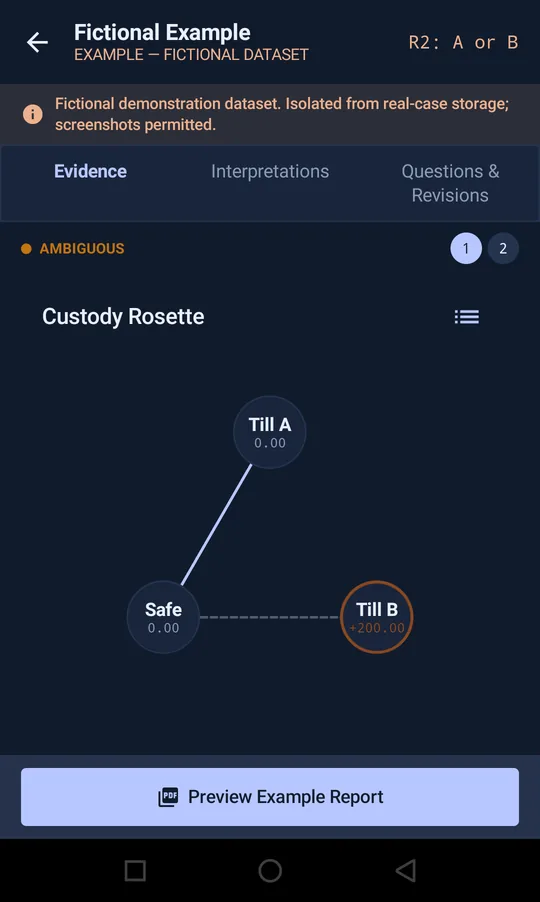
Evidence: the Custody Rosette
The Evidence tab draws each cash place as a circle and each movement as a line. A toggle switches to the Transfer Table, an ordered list of the same transfers.
The fictional example: Till A 0.00, Safe 0.00, Till B +200.00, marked AMBIGUOUS.
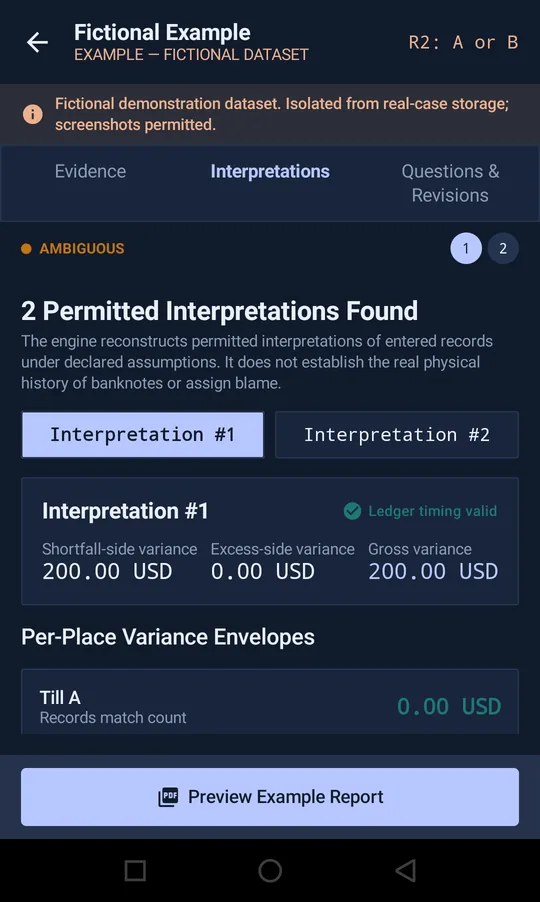
Interpretations, side by side
The Interpretations tab says: “The engine reconstructs permitted interpretations of entered records under declared assumptions. It does not establish the real physical history of banknotes or assign blame.” Each one shows Shortfall-side variance, Excess-side variance and Gross variance, then each place as Records above count, Count above records or Records match count.
“2 Permitted Interpretations Found”, with Interpretation #1 open.
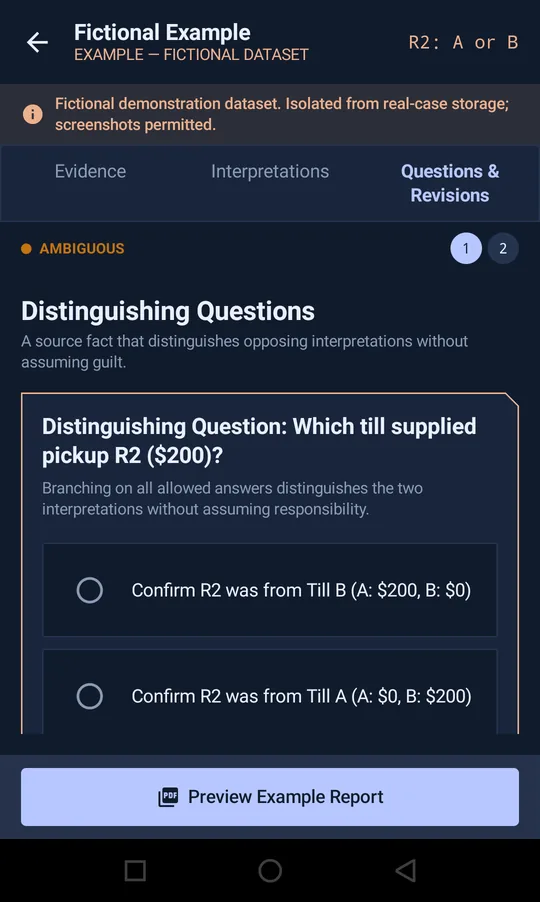
The one missing detail
Questions & Revisions lists Distinguishing Questions: “A source fact that distinguishes opposing interpretations without assuming guilt.” A Revision Ledger keeps an append-only history, so past evidence is not silently rewritten.
“Which till supplied pickup R2 ($200)?” with two choices to confirm.
How a case is entered
- New Case opens Create New Case: a title, a currency code and the decimals (0, 2, 3), and two tick boxes, “Scope bounded (all relevant places/counts entered)” and “Explicit assumption: no unrecorded cash flows”.
- Add Cash Location names each place (“Till 1, Safe”), with an option for a transit place such as a courier bag. Add Count Checkpoint and Add Movement Report take the counts and the pickups.
- Calculate then lists the permitted interpretations. The records say that when you do not declare the scope bounded, results stay unassessed, and that an unknown closing count makes the affected comparison Unassessed.
Where it stops
- It does not say who is responsible, and it gives no ranking or score of any person.
- It does not know whether a banknote moved, whether a slip is genuine, or what physically happened. The project’s own limits say so.
- It works only from what you enter. A wrong count in gives a wrong list out.
- It does not say a period balances when a shortfall and an excess cancel out.
- It is no replacement for a qualified accountant, whose independent review of the app is listed in its records as not yet done.
What it keeps, and where
The privacy policy says the case titles, place names, counts, slips, assumptions, notes and results are stored on your device unless you choose to export or share them, encrypted with a key held in the Android Keystore. Export happens only when you start it, through Android’s share sheet. It offers encrypted case archives with the file ending .dpkz, and says cloud backup is switched off.
There is an optional App PIN of 4 to 8 digits and an optional biometric unlock. The app’s own manifest lists one permission, for biometric unlock, and no internet permission.
What I did not check
I read the store listing, the project records, the app’s text, the privacy policy and the manifest, and I opened the three store pictures. I did not run the app myself. The records disagree on phone checks: one says a release build ran cleanly on a phone, an earlier one says the device checks were blocked. So I name no device and no test result. I did not inspect the signed release’s merged manifest. I also do not know how well the app handles a real shop’s records, which is why I show only its fictional example.
View Dopokaz on Google PlayUtah State University, Controller’s Office
“Cash Handling Procedures”. No date shown on the page. Read in full on 2026-11-13. Used for the counting steps, including blind balancing.
Ohio University, Office of the Bursar
“Cash Handling Guidelines”. No date shown on the page. Read in full on 2026-11-13. Used for the worksheet and for reconciling a count to the register report.
Closing with a short till?
Count it blind, count it again, write it down. Then list what the records allow before anyone decides what happened.